AI in Construction BIM 2026: Autodesk, Procore, Trimble, and the Jobsite Reality
Where AI actually lives in the 2026 BIM and construction tech stack — Autodesk Construction Cloud and Forma, Procore Copilot, Trimble Connect, document AI for RFIs and submittals, clash detection, and jobsite safety vision.

Construction has been the slowest large industry to digitize and the slowest to adopt AI in production. There are good reasons — every project is a one-off, the workforce is mobile, the tolerances are physical, and the margin pressure on general contractors leaves little appetite for capex on uncertain technology. By 2026 that has finally started to change, mostly because the big platform vendors (Autodesk, Procore, Trimble) bundled AI into products that contractors already use rather than asking them to adopt a new tool.
This is where AI actually lives in the construction tech stack today, what it does well, and what the honest limitations still are.
The platform layer: Autodesk, Procore, Trimble#
The three platform vendors that matter for AI in construction are Autodesk, Procore, and Trimble. Each has shipped meaningful AI capabilities in the last 24 months and each is approaching the problem from a different angle.
Autodesk Construction Cloud consolidates the BIM 360, PlanGrid, Assemble, and Pype products under one roof. Autodesk’s AI investment in 2024 and 2025 went into generative design (in Forma, the new architectural design environment that replaces parts of the old Revit and FormIt workflow) and into Construction IQ, the predictive risk and quality module that surfaces likely safety and quality issues from project data. Forma in particular is the most aggressive bet — early-stage conceptual design driven by AI that proposes massing, site, and energy options.
Procore Copilot launched in 2024 and by 2026 is in general availability across the platform. The Copilot is most useful in three places: natural-language search across project documents, summarization of long RFI and submittal threads, and drafting of common project communications. Procore’s bet is that AI as a workflow layer over their existing project management surface area is more valuable than AI as a standalone product.
Trimble Connect is the BIM collaboration product, and Trimble’s broader AI push is across their construction layout, machine control, and surveying products. The notable shift is that Trimble has the physical-world data — total stations, GPS rovers, machine control — that pure software vendors do not, and they are starting to push that data back into the BIM model in near real time.
Document AI for RFIs and submittals#
A meaningful share of a project engineer’s day is spent on RFIs (requests for information), submittals, and change orders. These are document-heavy workflows: a subcontractor asks a question, a project engineer routes it, the design team answers, the answer feeds back into the model and into the field. Multiply by thousands per project.
Document AI is the most boring and the most useful application of AI in construction. The patterns that are actually deployed:
Classify incoming submittals against the spec sections they relate to, so they route automatically. Extract the relevant requirements from the spec section and pre-populate the review template. Summarize the discussion thread on an RFI so a new reviewer does not have to read forty back-and-forth emails. Surface the prior similar RFIs on this project or other projects so the engineer is not answering the same question for the third time.
Procore Copilot, Autodesk’s review tooling, and several smaller vendors (Document Crunch, Outbuild, Briq) operate in this space. The productivity gains are real and the risk profile is low because a human still signs the response.
Clash detection and constructability#
Clash detection between trades is the textbook BIM use case and it long predates modern AI. Navisworks has done geometric clash detection for years. What AI adds is prioritization, root cause analysis, and learning from how clashes were resolved on past projects.
The current state in 2026 is that geometric clash detection is solved. The harder problem — which clashes actually matter, in what sequence to resolve them, and what the right resolution is given the trades and the schedule — is partially solved and getting better. Several startups (Avvir, BuildingSP, ClashMEP, and the in-product capabilities of Autodesk and Trimble) are working this layer.
There is also the related problem of constructability review: can this thing actually be built, in this sequence, with this crew, in this site condition? AI is starting to make progress here but it remains the kind of judgment call that a senior superintendent does well and software does adequately.
Safety AI on jobsites#
Computer vision for jobsite safety has been promised for a decade and is, by 2026, finally in real deployment at scale. The vendor history is itself instructive: Smartvid.io was the early leader; they were acquired into the Procore ecosystem as part of Construction IQ; Newmetrix (formerly Smartvid.io spinout) continued the standalone product line; Versatile (the crane-mounted hook cam) brought the camera to the equipment rather than the site; Buildots, OpenSpace, and DroneDeploy brought 360 capture and progress AI as a related category.
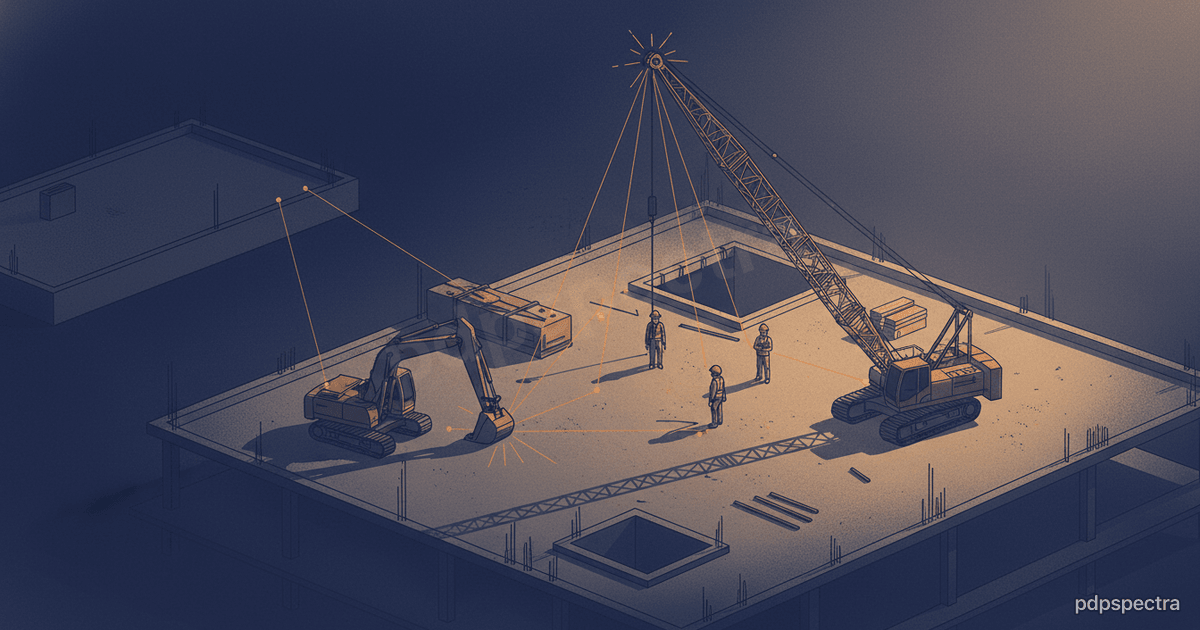
The actual safety vision use cases in production: PPE detection (hardhat, vest, harness), fall hazard detection at edges and openings, line-of-fire detection where a worker is near operating equipment, and ergonomic risk detection. The honest accuracy is good enough for daily summary reporting and trend tracking; it is not good enough for real-time alerting in a way that does not generate excessive false positives. Most successful deployments use the AI as a leading indicator that feeds the safety team’s daily briefing rather than as an alarm system.
Progress capture and schedule reconciliation#
OpenSpace, Buildots, and DroneDeploy walk or fly the site, capture imagery, and reconcile it against the BIM model and schedule. The pitch is that you no longer need a project engineer to walk the site weekly with a clipboard to mark percent complete by area.
In 2026 this works well enough that several large general contractors have made it standard on jobs over a certain size. The data quality is good for self-perform trades on commercial concrete and steel structures and weaker on MEP rough-in and finishes where the work is hidden or the geometry is harder to capture.
What is still hard#
Heavy civil and infrastructure remains a weaker fit for the current generation of construction AI. The reasons are geometric — long linear sites, less BIM adoption, more equipment-centric workflows. Trimble and Caterpillar dominate this segment with machine control and telematics rather than software AI.
Residential construction remains nearly untouched by the platform vendors above. The economics do not support it. Where AI shows up in residential is at the production homebuilder scale (D.R. Horton, Lennar) for design standardization and supply chain.
Field labor adoption is the perennial problem. Tools that require a foreman or a journeyman to interact with a tablet during the workday have to compete with the reality that the work is physical, dirty, and time-sensitive. The vendors that succeed design for very low friction.
Where pdpspectra fits#
Our data engineering practice and business automation practice help construction firms integrate Autodesk Construction Cloud, Procore, and field capture data into reporting and decision workflows that actually inform the next project.
Related reading: the AI-assisted BIM Revit plugins post, construction document AI for spec extraction, and AI construction safety vision.
Construction AI is finally getting boring, which is the right direction. Talk to our team about embedding AI into your construction tech stack.