Alphabet Plans $80B AI Infrastructure Raise: What the Hyperscaler Capex Race Means
Alphabet AI investment 2026: $80 billion infrastructure raise, hyperscaler capex race, datacenter buildout, nuclear PPAs, and what it signals for Gemini pricing and enterprise capacity.

Alphabet said on June 1, 2026 that it plans to raise eighty billion dollars to fund its AI infrastructure buildout. The figure sits inside a broader capex pattern across the four big US hyperscalers that has reshaped both equity markets and the physical electricity grid in the span of about three years. For enterprise teams quietly running their own AI roadmaps, the question is less whether Big Tech is overspending and more what this means for the Gemini quota you renew in October, the GPU SKU your fine-tuning team can actually get its hands on, and the inference price you build into your unit economics for 2027.
The eighty-billion-dollar number in context#
Alphabet has been on an accelerating capex curve since 2023 — first as a response to the genAI shock, then as a deliberate strategic bet that the floor on inference demand keeps rising. The eighty-billion-dollar raise is on top of operating cash flow that already funds tens of billions of dollars of annual infrastructure spend. Reporting across the cycle has put 2025 hyperscaler capex broadly in the range of eighty billion at Microsoft, north of sixty billion at Meta, and approaching one hundred billion at Amazon when both AWS and the Project Kuiper buildout are included. Numbers in this range move with each quarterly update — the directional point is the same: every major hyperscaler is now sustaining infrastructure spend at levels that used to be reserved for entire national utility programmes.
The raise itself is a tell. Alphabet has historically been the most cash-rich of the four and the least reliant on debt to fund growth. Choosing to raise external capital — rather than leaning entirely on operating cash flow — implies the company sees a window in which infrastructure has to scale faster than even its prodigious cash generation can support. That is a directional statement about demand intensity, not just balance-sheet management.

What the money actually buys#
Capex of this magnitude breaks into three roughly equal categories: silicon, real estate, and power.
Silicon is the line item the financial press fixates on, and reasonably — TPU v6 and v7 build-out at Google, the H200 and Blackwell generation at Nvidia-purchasing peers, and the custom inference accelerator program at every hyperscaler are all genuinely expensive. But silicon is the easy part to model because the unit economics are visible.
Real estate is the line that has quietly become the hardest. Hyperscale datacenter sites of one hundred to four hundred megawatts each are now multi-year construction programmes. Land acquisition, water-rights negotiation, fibre interconnect, transformer lead times — every one of those is now a binding constraint. Hyperscalers have stopped optimising for cheapest site and started optimising for “site we can actually energise on the timeline we promised the board.”
Power is the line that ties the other two together and is the most novel from an enterprise-procurement perspective. We will spend the rest of this piece there, because it is where the next phase of this cycle is going to surprise people.
Three Mile Island, Kairos Power, and the nuclear option#
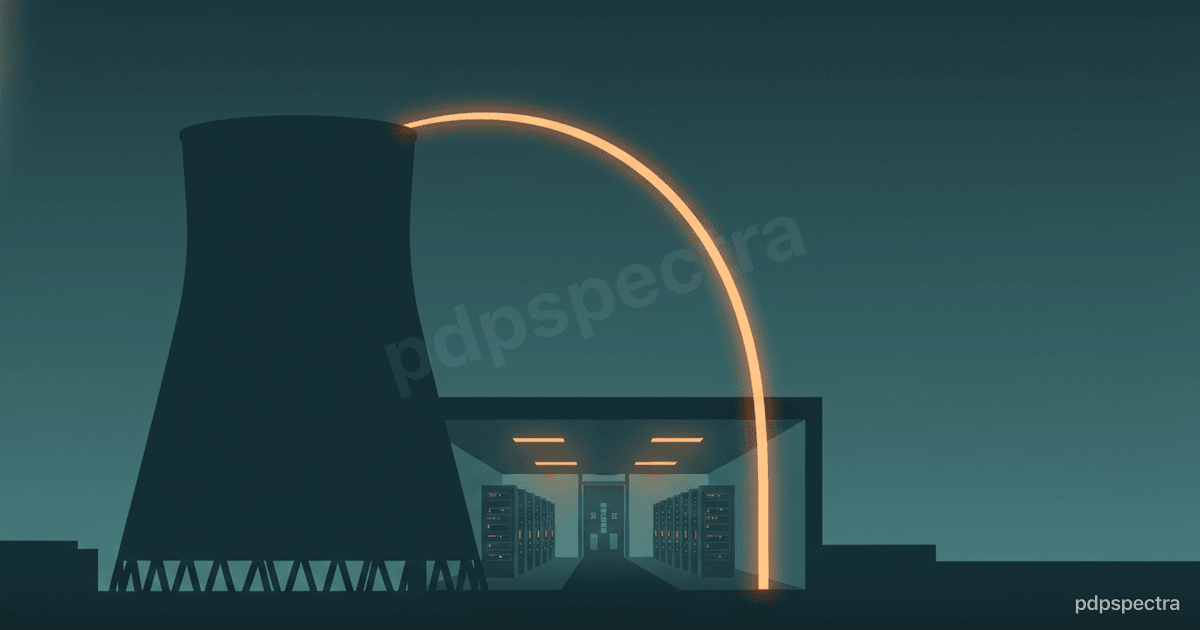
The most under-priced fact in 2026 hyperscaler infrastructure is that all four of the US majors have effectively become utility customers at sovereign scale. The Three Mile Island Unit 1 restart agreement between Microsoft and Constellation Energy, signed in 2024 with a target restart of around 2028, set the template. Google’s power purchase agreement with Kairos Power for small modular reactors — first units targeted for the late 2020s — moved the conversation from “nuclear is a thought experiment” to “nuclear is in the procurement pipeline.”
Why nuclear and why now. Two reasons. First, the load profile of a hyperscale AI campus is genuinely baseload — twenty-four hours a day, seven days a week, with very limited tolerance for interruption. Wind and solar plus storage can serve a meaningful share of that load, but the firm power portion is what gets paid attention. Second, hyperscaler power needs are now large enough that signing PPAs for new generation is cheaper than fighting other industrial customers for existing grid capacity in congested ISO regions.
The implication for enterprise buyers is subtle but real. The cloud vendors are increasingly differentiating not just on chip availability but on regional carbon intensity and firm-power access. If your AI workloads have a regulated reporting requirement — and in financial services, healthcare, and EU manufacturing they increasingly do — the hyperscaler region you pick is going to carry an embedded power story that did not exist when the original cloud-region strategy was written in 2018.
Stargate, the cross-hyperscaler context#
The Stargate Project — announced as a roughly five-hundred-billion-dollar AI infrastructure programme led by SoftBank, OpenAI, and Oracle with US government engagement — sits as the maximalist version of the same trend. Whether Stargate hits the announced number on the announced timeline is a separate question. What it does, at minimum, is set a ceiling for what private capital is willing to deploy into AI infrastructure when one of the frontier labs is the anchor tenant.
Alphabet’s eighty-billion-dollar raise has to be read against that backdrop. Even if Stargate undershoots, the fact that competitor capital pools of that magnitude are in the market means Alphabet cannot prudently underspend. The strategic logic — own the underlying infrastructure for your frontier model so your competitor cannot rent capacity faster than you can build it — only works if every credible competitor is funded to the same scale.
The ROI question every CFO is asking#
The single hardest question in the room, at every hyperscaler board meeting and every enterprise tech-strategy offsite this year, is when AI capex stops being a moonshot and becomes depreciating infrastructure. The honest answer is: probably not on the schedule the bulls expect, but probably also not as catastrophically as the bears warn.
The depreciation lens helps. Servers depreciate over four to six years on most hyperscaler books. AI accelerators are being depreciated on shorter useful-life assumptions — three to five years is now common — because the pace of architectural improvement is faster than the prior CPU and GPU generations. That shorter useful life means that today’s eighty-billion-dollar raise translates into a higher annual cost-of-revenue line for the next several years, which is exactly why margin compression keeps coming up on hyperscaler earnings calls.
For enterprise buyers, the practical takeaway is that hyperscaler cloud margins are unlikely to fund the kind of aggressive multi-year price cuts that some procurement teams are quietly hoping for. Discount cycles will still happen at the SKU level, especially on older accelerator generations, but the headline list price on the latest inference tier is going to stay sticky.
What the capex race means for Gemini pricing and capacity#
Four concrete reads for enterprise teams who run Gemini in production.
First, capacity for the Gemini 2.5 and 3.x family at the high end is going to be uneven through 2026 and into 2027. Alphabet is funding capacity expansion precisely because today’s capacity is constrained. Teams that committed to Gemini for a workload should be holding active conversations about reserved capacity rather than assuming on-demand will always be there. The reserved-capacity conversation is materially easier when you walk in with a multi-quarter forecast of token volume rather than an open-ended ask.
Second, price-per-token at the Flash and Nano tiers is going to keep falling. The marginal cost of TPU inference at scale falls roughly with each generation, and Alphabet has every commercial reason to keep pushing the low-end price down to lock in volume. Workloads that can route to cheaper tiers should be doing so already, and the router should be evaluated on a monthly cadence rather than treated as a one-time architectural decision.
Third, the enterprise commercial team at Google Cloud has more room to discount on annual committed-use contracts in 2026 than the equivalent team at AWS or Azure. That window will close as the new infrastructure comes online, but for the next renewal cycle it is real. Negotiate hard on the Gemini line item specifically — separate from BigQuery, Vertex AI, and the broader Google Cloud commit — because the unit economics for inference and analytics move on different curves.
Fourth, regional capacity is going to vary more than at any time in the cloud era. The combination of land, power, and water constraints means that even an extremely well-funded buildout cannot ship capacity uniformly across every Google Cloud region. Enterprise workloads with hard data-residency requirements should validate regional capacity availability with their Google Cloud account team before committing architecture to a specific region for the next refresh cycle.
Where pdpspectra fits#
We help enterprise teams sit on the right side of this capex cycle — negotiating capacity, designing portable inference architectures, and building unit economics that survive vendor price shifts. Our cloud infrastructure practice is where these conversations usually land.
Related reading#
If your team is planning the next Gemini, TPU, or hyperscaler commitment, we can help you negotiate against the real capex backdrop rather than the press-release version. Get in touch and we will share the procurement playbook we use with platform leadership.