Green Hydrogen Production in 2026: Plug Power, Nel, ITM Power, the EU Hydrogen Bank, and the H2Hubs Reality
Plug Power, Nel, ITM Power, Cummins Accelera, Linde, Air Liquide, electrolyzer cost trajectory, the EU Hydrogen Bank auction rounds, the US H2Hubs program, and the actually-shipped projects versus the announced.

The green hydrogen story in 2026 is the textbook example of a climate-tech sector going through the difference between announced and shipped. The mid-2022 wave of corporate and government announcements projected hundreds of gigawatts of electrolyzer capacity online by 2030. The actual installed capacity at the start of 2026 is in the single-digit gigawatts. A meaningful number of headline projects have been delayed, downsized, or cancelled. The EU Hydrogen Bank’s first auction in late 2023 cleared at lower prices than expected. The US H2Hubs program announced in October 2023 has moved slowly through the planning phase.
The honest read is not that green hydrogen has failed — it has not — but that the gap between policy ambition and operational reality is wider than the 2021-2022 communications suggested. This post is the engineer-friendly tour of what is actually shipping, where the cost trajectory is, and what the EU and US policy frameworks have actually delivered.
What “green hydrogen” means in 2026#
Green hydrogen is hydrogen produced by electrolysis powered by renewable electricity, with the upstream renewable generation accounted for under the local “additionality” and “temporal correlation” rules. The complementary terms are blue hydrogen (steam methane reforming with carbon capture), grey hydrogen (steam methane reforming without capture, the dominant industrial source historically), and pink hydrogen (electrolysis powered by nuclear).
The price benchmark in 2026 for green hydrogen is in the 4-8 USD per kilogram range delivered, depending on geography, renewables cost, electrolyzer technology, and policy support. The price benchmark for grey hydrogen is roughly 1-2 USD per kilogram. The 45V tax credit in the US (up to 3 USD per kilogram for the cleanest tier) and the EU Hydrogen Bank subsidy structure (premium per kilogram negotiated through auction) close part of the gap. The remaining gap is what scaled deployment has to close through learning curves and renewables cost reductions.
Electrolyzer technology choices#
The three main electrolyzer technologies have different cost and operating profiles.
Alkaline electrolyzers. The mature workhorse — Nel, Cummins Accelera (formerly Hydrogenics), Sunfire, McPhy, ThyssenKrupp Uhde. Lowest capital cost per megawatt, well-understood operating characteristics, less responsive to varying renewable power input. Dominant choice for large industrial-scale plants.
Proton exchange membrane (PEM) electrolyzers. Plug Power, ITM Power, Nel (also has PEM), Siemens Energy. Higher capital cost per megawatt, more responsive to varying input — better match for intermittent renewables. Use platinum-group catalysts, which are an ongoing cost concern.
Solid oxide electrolyzers (SOEC). Bloom Energy, Sunfire, Topsoe. Highest efficiency, can integrate with industrial heat sources, less mature commercially. Several pilot deployments through 2024-2025.
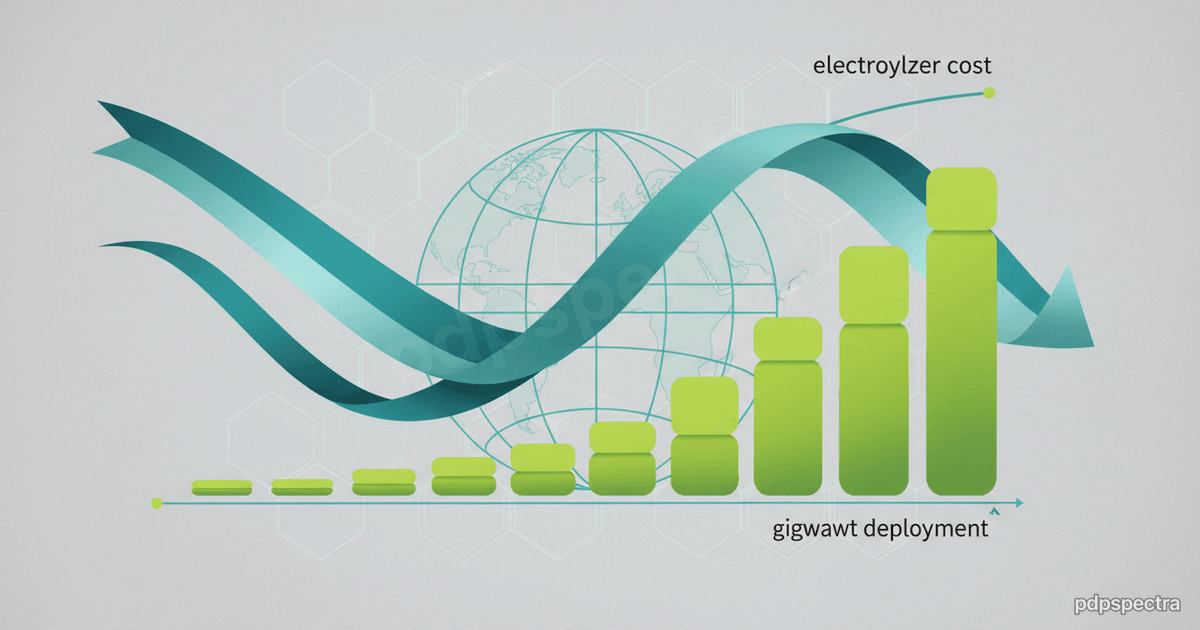
The electrolyzer cost trajectory has been slower than the early-2020s forecasts suggested. The IRENA target of 200 USD per kilowatt for alkaline by 2030 looks unlikely; the realistic 2026 number is in the 500-800 USD per kilowatt range for alkaline at large scale, somewhat higher for PEM. The path to lower costs runs through manufacturing scale-up (gigawatt-class production lines, of which only a handful are operational) and material efficiency improvements.
Plug Power and the verticalization bet#
Plug Power has been the most aggressive verticalization story in green hydrogen — producing electrolyzers, building hydrogen production plants, supplying liquid hydrogen, selling fuel cells to logistics and forklift customers. The 2024-2025 period was hard for Plug: substantial financial losses, the New York Concept plant in Genesee County coming online with operational growing pains, going-concern disclosures and refinancing through 2024.
The Plug story is interesting because the verticalization thesis was right in concept — if green hydrogen is going to work, someone has to build the production-to-end-use loop — but the execution has been expensive. The 2025 turnaround work has focused on closing unprofitable parts of the business and concentrating on electrolyzer sales and select hydrogen production sites. Whether Plug emerges as a viable major player or as a cautionary tale is one of the open questions of 2026.

Nel, ITM Power, and the pure-play electrolyzer vendors#
Nel ASA is the largest pure-play electrolyzer manufacturer with both alkaline (Heroya, Norway) and PEM (Wallingford, Connecticut) production. The 2024-2025 order book has been mixed — a number of high-profile projects announced earlier have been delayed or downsized as final investment decisions slipped. Nel’s strategic posture has been to focus on industrial-scale alkaline rather than chase distributed PEM.
ITM Power is the UK PEM specialist with the Bessemer Park gigafactory in Sheffield. The 2024-2025 commercial focus has been on industrial customers and the Vitol partnership for trading platform integration. ITM has also gone through restructuring as electrolyzer demand has been slower to materialize than projected.
Cummins Accelera (the rebranded Hydrogenics under Cummins ownership) covers both alkaline and PEM and benefits from Cummins’s existing industrial distribution. The 2024-2025 deployments have been steady rather than spectacular.
Siemens Energy is the most credible large-incumbent player with the Silyzer PEM platform and deep industrial relationships. Several large-scale projects in Germany and the Netherlands are on Siemens electrolyzers.
The pattern across all the pure-play electrolyzer vendors is similar: real but slower-than-projected demand, gigawatt-class manufacturing capacity that is partly utilized, and dependence on policy support to push final investment decisions over the line.
Linde, Air Liquide, and the industrial-gas incumbents#
Linde and Air Liquide are the two largest industrial gas companies and are the incumbents who actually supply most of the hydrogen used in industry today. Both have been moving substantial capital into green hydrogen production for their existing customer base — refineries, chemicals, steel. Linde’s Niagara Falls plant came online in 2024 with PEM electrolyzers from ITM Power; Air Liquide’s projects in Normandy, Quebec, and the Netherlands are at various stages of construction or commissioning through 2024-2026.
The industrial-gas incumbent advantage is that the customer relationship and the distribution infrastructure already exist. The challenge is that the price gap between grey and green hydrogen still needs to be closed by policy support for the existing customer base to accept the higher prices.
The EU Hydrogen Bank and the auction results#
The European Hydrogen Bank’s first auction in late 2023 (December 2023 results) was the first large-scale price discovery for the EU green hydrogen market. The cleared prices were lower than the pre-auction analyst expectations — in the range of 0.37 to 0.48 EUR per kilogram of fixed premium over a ten-year period — which was either a bullish signal (developers are confident they can produce green hydrogen at competitive cost) or a bearish signal (the projects bidding at low premiums may struggle to actually deliver at those prices).
The 2024 follow-up auction continued the same pattern with similar clearing prices. The total committed support through the first two auctions covered several gigawatts of nominal capacity. The 2025-2026 question is how many of the awarded projects reach final investment decision and how many quietly walk away or renegotiate.
The EU Hydrogen Bank structure is recognizably similar to the Contracts for Difference structure that worked for offshore wind in the UK and Europe. Whether it works similarly well for green hydrogen depends on the underlying technology and renewables cost trajectory.
The US H2Hubs program and the slow start#
The US Department of Energy H2Hubs program — 7 billion USD across seven regional hubs, announced in October 2023 — was the largest single US policy intervention in hydrogen. The seven hubs (Appalachian, California ARCHES, Gulf Coast HyVelocity, Heartland, Mid-Atlantic MACH2, Midwest MachH2, Pacific Northwest PNWH2) cover different mixes of green, blue, and pink hydrogen with different end-use customers.
The 2024-2025 progress has been slow. Phase 1 planning and project development took most of 2024. The 45V production tax credit final rules from Treasury in late 2024 were the long-awaited piece — establishing the three-pillar approach for additionality, temporal correlation, and deliverability of the renewable electricity. The rules were broadly seen as workable but stricter than the industry had hoped, particularly on temporal correlation (hourly matching starting in 2030).
The hub-by-hub pace through 2025 and into 2026 has varied. Some hubs (California ARCHES, Gulf Coast HyVelocity) moved faster on early projects. Others have been slower on offtake agreements with end users. The combination of 45V credit, regional grants, and corporate offtake commitments is what each hub needs to close on; the math is tight enough that delays are common.
What this means for technology teams#
For platform and data teams working with green hydrogen projects in 2026, the operational picture is recognizable to anyone who has built industrial-scale data pipelines. Telemetry from electrolyzers, integration with renewable energy procurement and 45V hourly matching, MRV-style reporting for the policy framework, and integration with the customer side (refineries, chemicals plants, fuel cell fleets). The data layer is recognizable; the regulatory specifics are new.
We have helped industrial operators stand up the data engineering backbone for this kind of platform. The 45V hourly matching requirement in particular is a real data-engineering problem — every megawatt-hour of hydrogen production has to be matched to a contemporaneous megawatt-hour of qualifying renewable electricity, with rigorous time-stamped records that satisfy IRS audit. Teams that have built carbon-accounting platforms recognize the pattern.
Related reading#
- Direct air capture economics in 2026
- Carbon capture tech in 2026
- Climate tech carbon accounting in 2026
Green hydrogen is real but the gap between announced and shipped is wide. If your organization is sizing the data infrastructure for an electrolyzer operator or industrial offtake program, our data engineering team has built this kind of pipeline. Tell us about the program.