The Quantum Computing Landscape in 2026: Heron, Willow, H2, Forte Enterprise, and the Road to Fault Tolerance
IBM Heron, Google Willow's error-correction milestone, Quantinuum H2, IonQ Forte Enterprise, PsiQuantum's photonic bet, Rigetti, AWS Braket, and Azure Quantum — where the field actually sits in 2026.

The honest summary of quantum computing in mid-2026 is that the field has finally separated the hardware vendors who will plausibly cross into fault tolerance from those who are running on conference-talk fumes. The last eighteen months produced more real milestones than the previous five years combined — Google’s Willow chip demonstrated error correction below threshold in December 2024, IBM shipped Heron with materially better two-qubit fidelity, Quantinuum’s H2 logical qubit work crossed several thresholds, and Atom Computing demonstrated more than 1000 neutral atom qubits. None of this is a “quantum computer that breaks RSA tomorrow” story. All of it is a “the engineering is now serious” story.
This is the practical landscape map for a CTO or platform lead who needs to know which vendor, which platform, and what to actually expect.
The thirty-second physics framing#
Quantum computers store information in qubits — quantum states that can be superpositions of zero and one. The hard part is keeping those states coherent long enough to run a useful circuit. Every gate operation introduces error; every nanosecond of decoherence is a tax. The 2010s gave us NISQ — Noisy Intermediate-Scale Quantum — devices with tens to hundreds of physical qubits and error rates that limited useful depth to a few dozen gates. The path forward is fault tolerance: bundle many physical qubits into one logical qubit using error-correcting codes (surface code, color codes, qLDPC), so the logical error rate is exponentially lower than the physical rate. The catch is that doing this needs physical error rates below a threshold, and many thousands of physical qubits per logical qubit.
Until Willow, no one had publicly demonstrated that adding more physical qubits actually lowered the logical error rate. Willow did. That is the single most important quantum result of the last two years.
IBM Heron and the modular path#
IBM’s roadmap is the most explicitly published in the industry, which means it is also the most easily judged. Heron, shipped in late 2023 and iterated through 2024 and 2025, hits two-qubit gate fidelities in the 99.9% range with materially better crosstalk than the older Eagle processor. Heron r2 expanded to 156 qubits per chip. The 2024-2025 IBM Quantum System Two demonstrators chained multiple Heron chips through cryogenic links, which is the real engineering bet — modular rather than monolithic scaling.
The IBM thesis for 2026-2029 is qLDPC error correction (rather than the surface code most others use), which gets to fault tolerance with roughly an order of magnitude fewer physical qubits per logical qubit. The Quantum Starling target announced in 2024-2025 is hundreds of logical qubits by 2029. Whether that timeline holds is the open question; the engineering posture is the most credible in the superconducting camp.
Google Willow and error correction below threshold#
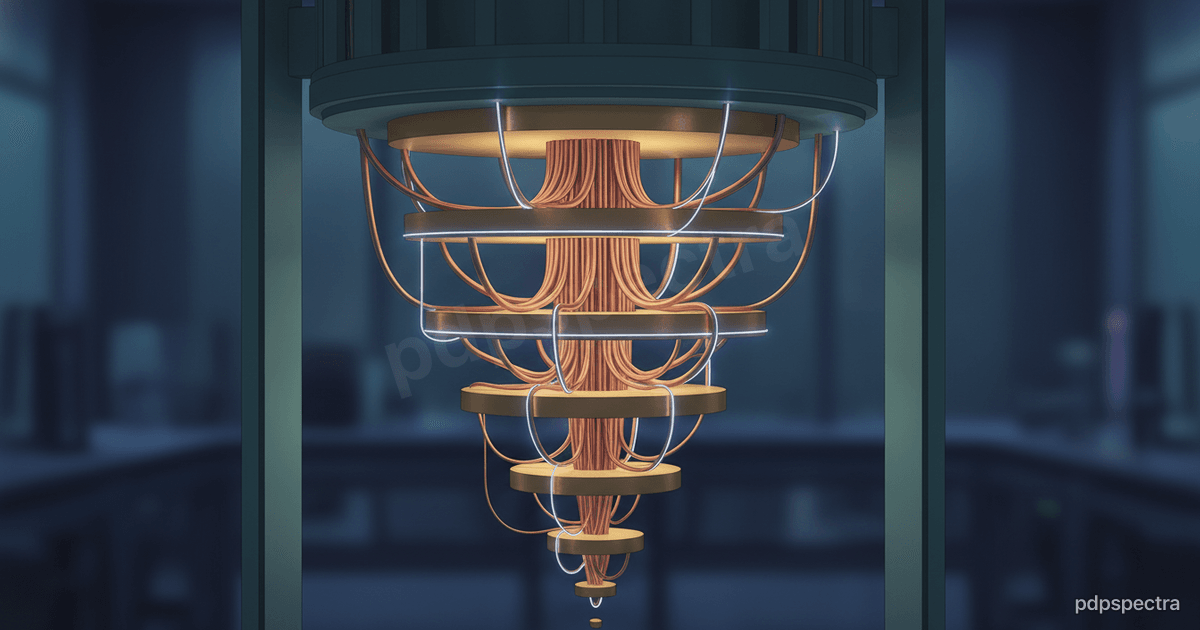
Google’s Willow processor (December 2024 announcement) is the result the field had been waiting on for a decade. By going from a distance-3 to a distance-5 to a distance-7 surface code on the same hardware, Google showed that logical error rates dropped exponentially as code distance grew. This is the textbook signature of being below threshold. The chip itself is 105 qubits with state-of-the-art two-qubit fidelity and dramatically improved T1 coherence times.
The Willow paper also revived the random-circuit-sampling supremacy claim with a more defensible margin. The sober reading is that error correction works in practice and that Google’s hardware has the fidelity headroom for the next several years of scaling. The unsober reading — that we are days away from breaking RSA — is wrong, and Google’s own statements have been careful about that.
Quantinuum H2 and trapped-ion logical qubits#
Quantinuum’s H2 is the leading trapped-ion machine. Ion traps run slower per gate than superconducting chips but get inherently higher fidelity — Quantinuum routinely reports two-qubit fidelities above 99.9% with all-to-all connectivity. The 2024 demonstration of a fault-tolerant logical qubit using the carbon code, with logical error rates lower than the physical rate, was the trapped-ion answer to Google’s surface-code result.
Quantinuum’s 2025 H2 expansion to 56 qubits and the announced Apollo machine targeting 100+ qubits keeps the architecture credible for the next stage. The trade-off is throughput: ion-trap circuits run at millisecond gate times rather than microseconds, which limits how many shots you can run in a given wall-clock window. For algorithms that need few shots but high fidelity, this is fine. For benchmark-heavy workloads, it hurts.
IonQ Forte Enterprise and the commercial trapped-ion bet#
IonQ’s Forte Enterprise generation, deployed through 2024-2025, ships on AWS Braket and Azure Quantum and represents the most accessible commercial trapped-ion offering. IonQ’s near-term wedge is sales channel and cloud integration rather than peak fidelity benchmarks, where Quantinuum still leads. The Tempo and Tempo Enterprise roadmap aims at 64-256 algorithmic qubits — IonQ’s preferred metric — by 2027-2028.
The IonQ story is interesting more as a commercial bellwether than a hardware leader. If trapped ions can win in the cloud, IonQ is the vendor that proves it.
PsiQuantum, the photonic outlier#
PsiQuantum’s bet is the most all-or-nothing in the industry: photonic qubits using silicon-photonics manufacturing, no intermediate NISQ machines, direct to a million-qubit fault-tolerant system. The 2024 announcements of facilities in Brisbane and Chicago are the first tangible deliverables of that bet — fab partnerships with GlobalFoundries, cryoplant engineering, and a stated target of a million-qubit fault-tolerant machine by 2027-2028.
The right framing is that PsiQuantum will either deliver the first real fault-tolerant machine or run out of cash trying. There is no NISQ business in between. For a buyer, this means PsiQuantum is not a 2026 vendor — it is a 2028+ bet. The Australian and Illinois state investments make the cash runway plausible.
Rigetti, Atom Computing, and the next tier#
Rigetti has scaled to 84 qubits with the Ankaa-3, with two-qubit fidelities around 99% and a path to higher counts through 2026. The challenge is closing the fidelity gap to IBM and Google; the path is in process improvements at their Fab-1.
Atom Computing’s 2024 demonstration of a 1180-qubit neutral-atom system on a single optical-tweezer platform was a different scaling argument — neutral atoms scale to thousands of qubits much more cheaply than superconducting or ion-trap, with the trade-off of slower reconfiguration and active research on gate fidelity. The partnership with Microsoft Azure Quantum announced in late 2024 demonstrated 24 logical qubits, the largest count in any technology at the time.
AWS Braket and Azure Quantum as buyer surfaces#
For anyone who is not buying their own dilution refrigerator, AWS Braket and Azure Quantum are how you actually touch hardware. AWS Braket fronts IonQ, QuEra (neutral atom), Rigetti, and IQM with a uniform SDK and per-shot pricing. Azure Quantum fronts Quantinuum, IonQ, Rigetti, and the resource-estimator tooling.

Neither cloud fronts IBM Quantum — IBM runs its own Quantum Platform — and Google’s hardware is not commercially exposed at this point. The practical answer for most enterprise teams: use Azure Quantum or AWS Braket for prototyping on real hardware, use the Qiskit and Cirq simulators for development, and budget for the fact that hardware-time pricing in 2026 still makes a ten-qubit experiment cost more than a thousand hours of GPU time.
The NISQ-to-fault-tolerant transition#
The mental model that matters in 2026: we are leaving NISQ. The era of trying to find useful computations that run on noisy hundred-qubit machines is ending, not because someone proved it impossible but because the error-corrected results have arrived. Investment, talent, and roadmap focus are shifting to fault-tolerant prototypes. The next four years are about scaling logical qubit counts from single digits to thousands, which is the regime where Shor’s algorithm and the Hamiltonian simulation workloads that drug-discovery and materials-science people actually want become reachable.
For an enterprise platform team, the 2026 question is not “should we run our optimization on a quantum computer.” It is “should we have someone tracking the field so we are not caught flat-footed when the curve bends.” For most CTOs, the answer is yes — and the post-quantum cryptography migration that we covered in our PQC migration deep-dive is the part you need to be acting on right now, not waiting.
What we tell platform teams#
For our cloud infrastructure work, the quantum advice we give to enterprise platform teams is narrow but firm. Spin up an AWS Braket or Azure Quantum sandbox so your team has hands-on familiarity. Pick one or two algorithm classes that map to your business — portfolio optimization, molecular simulation, certain ML kernels — and track them. Do not buy hardware. Do not build a quantum team. Do migrate to post-quantum cryptography on the timeline NIST has published, because that is the only part of the quantum story that is real and urgent in 2026.
The vendors that will still be standing in 2030 are likely IBM, Google, Quantinuum, IonQ, PsiQuantum (if the photonic bet pays), and Atom Computing. The hardware platform you actually use will be whichever one shows fault-tolerant logical qubit counts in the hundreds first.
Related reading#
- Post-quantum cryptography migration in 2026
- Snowflake vs Databricks vs BigQuery in 2026
- Bedrock vs OpenAI vs Anthropic for enterprise
Quantum computing in 2026 is finally an engineering field. If your organization needs help separating real milestones from press releases, our cloud infrastructure team tracks the landscape so platform decisions hold up. Tell us what you are sizing.