AI Antibody Design for Next-Gen Therapeutics
ML antibody design has reached the clinic: de novo diffusion, epitope-targeted design, developability prediction, and why biologics are the harder problem.

Small-molecule generative design gets the headlines, but the harder and arguably more valuable frontier is biologics. Antibodies are the workhorse of modern therapeutics — exquisitely specific, tunable, and responsible for a large share of the industry’s pipeline — and until recently you could not design one. You discovered it, by immunizing an animal or panning a phage library and hoping something bound. In 2026 that is changing, and the change is structural: models now propose antibody binders against a chosen epitope, from sequence and structure, before a single hybridoma exists.
The proof is in the clinic. Absci dosed the first participants in a Phase 1 trial of ABS-101, an anti-TL1A antibody for inflammatory bowel disease that came out of its generative design platform, engineered to bind both monomeric and trimeric TL1A and dosed on a quarterly subcutaneous schedule. Generate Biomedicines has pushed even further down the development path: GB-0895, an AI-engineered anti-TSLP antibody for severe asthma with a six-month dosing interval, is moving into global Phase 3 studies. These are not slideware. They are antibodies whose properties were tuned computationally and that are now being tested in humans.
This post is about how that works and, more usefully, where it breaks.
De novo design has actually happened#
The watershed was the demonstration that you can design an antibody binding region from computation alone, not just optimize an existing one. The Baker lab adapted RFdiffusion — the same diffusion framework used for general protein design — to the antibody problem, conditioning the generative process on a target epitope and denoising a complementarity-determining region into place. The first published binders were VHH (single-domain) antibodies against influenza hemagglutinin with affinities in the tens of nanomolar, and cryo-EM confirmed the designed structures matched prediction to roughly 1.45 angstroms backbone RMSD.
That work has since matured into something a drug program can use. The 2025 Nature paper on de novo antibody design with RFdiffusion extended the method from single-domain binders to full variable regions — paired heavy and light chains, the format most antibody drugs actually take — targeting user-specified epitopes. Critically, the RFantibody software was released for free, including commercial use, which means the capability is not locked inside one company. The barrier is no longer the model. It is everything around it.
Epitope targeting is the real unlock#
Discovery campaigns give you binders, but they do not let you choose where on the antigen the antibody lands. That matters enormously: function lives at specific epitopes. You might need to block one receptor interface and avoid another, or hit a conserved patch that does not mutate across viral variants. Traditional discovery treats the epitope as a lottery outcome; epitope-targeted design treats it as an input.
This is where structure prediction and generation fuse. To design against an epitope you need a reliable model of the antibody-antigen interface, and that is exactly what the new structure predictors deliver. Chai Discovery’s Chai-1 reports 52.9% DockQ success on antibody-protein interfaces, against 38.0% for the earlier AlphaFold-Multimer generation, with accuracy roughly doubling when known pocket residues are supplied. The follow-on, Chai-2, pushed into zero-shot antibody design directly — generating candidates against a target with experimental hit rates in the 16 to 20% range in a small-plate format. A hit rate in that band, from a cold start with no immunization, is the kind of number that changes how a discovery group allocates its bench time.
The pattern across all of this is consistent: structure prediction good enough to model the interface is the enabling layer, and generation conditioned on that interface is the payoff.
Why biologics are harder than small molecules#
It is tempting to assume antibodies are just a bigger version of the small-molecule problem. They are not, and the differences are what make this hard.
The sequence space is astronomically larger. A small molecule has tens of heavy atoms. An antibody variable region is hundreds of residues across two chains, and the CDR loops — the part that does the binding — are flexible and poorly constrained. You cannot brute-force this space, and the structure of the very loops you care about is the hardest part to predict.
Binding is necessary but nowhere near sufficient. A small molecule has to be absorbed and metabolized acceptably. An antibody has to be developable, and developability is a wall of correlated failure modes: aggregation propensity, viscosity at the high concentrations needed for subcutaneous dosing, chemical and conformational stability, solubility, and — uniquely and dangerously — immunogenicity. A designed sequence that has never existed in a human can provoke an anti-drug antibody response that quietly kills efficacy or, worse, causes harm. There is no small-molecule equivalent of “your drug teaches the immune system to neutralize your drug.”
Manufacturing is part of the molecule. A small molecule is defined by its structure; you synthesize it and you are done. An antibody has to express well in CHO cells, fold correctly, and survive purification at scale. A beautiful binder that titers poorly in a bioreactor is a research curiosity, not a product. Expression and manufacturability are design constraints, not afterthoughts.
This is why the serious platforms talk less about affinity and more about co-optimization. Generate Biomedicines frames its work as simultaneously optimizing binding, manufacturability, and immunogenicity, with an explicit focus on hard targets like multipass membrane proteins. Absci’s pitch for ABS-101 leads with reduced immunogenicity risk and a dosing-friendly profile, not just potency. The affinity is table stakes. The developable, manufacturable, low-immunogenicity package is the actual deliverable.
Developability prediction: useful, not solved#
Because developability is multi-dimensional and expensive to measure, it is a natural target for ML — and the models genuinely help. You can train predictors for aggregation, viscosity, thermal stability, and immunogenicity risk and use them to triage designs before committing expression slots. The honest framing is that these are filters that save you from obvious mistakes, not oracles that certify a candidate.
The reason is the same one that limits ADMET prediction for small molecules: the labeled data is scarce, proprietary, and biased toward what each company has historically measured. Immunogenicity in particular is brutal, because the ground truth involves a human immune system and only emerges late in development. A model that scores a designed antibody as low-immunogenicity is making an educated guess from sequence liabilities and MHC-binding proxies, not a guarantee. Treat developability scores as a way to spend wet-lab capacity wisely, and keep the wet lab as the arbiter.
The number to watch is the same one as always#
As with small molecules, judge an antibody platform by its confirmed experimental hit rate against a named epitope, not by how confident its predicted structures look. A pipeline that produces stunning in silico interfaces and a confirmed binder rate below 20% is doing worse than its dashboards suggest. Predicted DockQ is a proxy; a binder that shows up in an SPR experiment is the product.
Design versus optimization, and why the line matters#
A practical distinction separates two things that often get blurred. De novo design generates a binder from nothing against a chosen epitope — the headline capability, and the genuinely new one. Sequence optimization takes an existing antibody, from discovery or a prior program, and tunes it: improving affinity, removing developability liabilities, humanizing it, or extending half-life. Most clinical-stage AI antibodies today are closer to the optimization end than the pure de novo end, and that is not a criticism — it is where the risk-adjusted value sits right now.
The reason is that optimization starts from a molecule the immune system has already, in a sense, vetted, and narrows the search to a region of sequence space where developability is more predictable. GB-0895’s headline feature is a six-month dosing interval, which is an engineering achievement in half-life and potency, not a from-scratch binder. ABS-101’s pitch centers on binding two forms of its target with reduced immunogenicity risk. These are optimization wins expressed through generative tooling. The pure de novo capability — design a binder against an arbitrary epitope with no starting antibody — is advancing fast in the literature but is the harder bar to clear in a regulated program. An honest platform is explicit about which mode produced a given candidate, because the failure risks are different.
Multispecifics raise the stakes#
The direction of travel is toward bispecific and multispecific antibodies — molecules that engage two or more targets at once, increasingly central to immuno-oncology and immunology. These are even harder to design and to manufacture: chain pairing, geometry between binding arms, and a multiplied developability surface. Computational design is arguably more valuable here precisely because the combinatorics defeat discovery-by-screening, but the developability and expression risks compound rather than add. If a single-target antibody is a hard optimization problem, a multispecific is several coupled ones, and the data platform that tracks which arm, which linker, and which format produced which result is what keeps the program legible.
The engineering underneath#
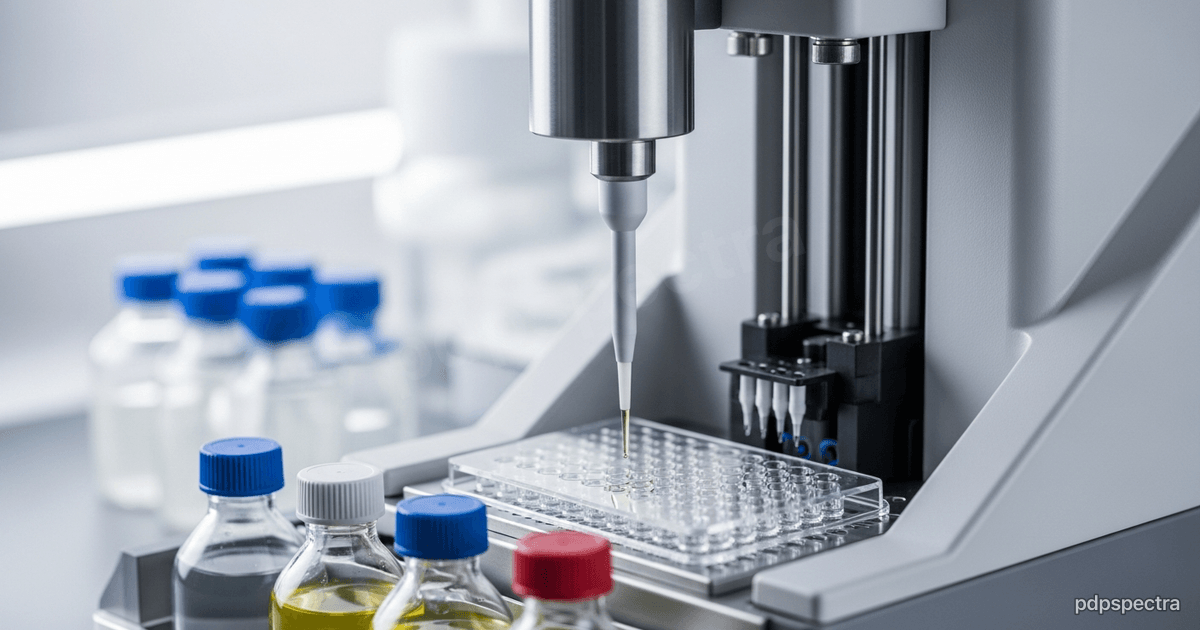
Strip the biology away and an antibody-design program is the same shape as any serious AI implementation: a generative or predictive model is one stage in a long, instrumented loop, and the value is in the loop’s discipline. Every designed sequence needs provenance — which model version, which epitope, which developability scores, which expression result, which binding assay. The teams that win build a real Data Platform under this: versioned designs, structured assay capture, and a feedback path that pushes confirmed wet-lab outcomes back into the next design round. Operational Automation of the design-express-test cycle, with liquid handlers and tracked plates rather than spreadsheets, is what lets the loop turn fast enough to matter.
The same instincts that make a Hospital Management System trustworthy — traceability, versioning, an auditable chain from input to outcome — are exactly what make a biologics design platform trustworthy. The chemistry is exotic; the data engineering is not, and the data engineering is where most programs actually live or die.
The state of play in 2026 is clear: de novo antibody design works, epitope targeting is real, and AI-designed antibodies are in human trials. The models have crossed a threshold. Developability, immunogenicity, and manufacturability remain stubborn, data-limited problems, and the platforms that respect that — and build the loop to learn from every wet-lab result — are the ones turning designs into drugs.
Designing biologics and need the instrumented loop — provenance, automation, and feedback — built around your models? Talk to our team. We engineer the data platforms that make computational design reproducible and auditable.