AI in Logistics Route Optimization 2026: Wise Systems, Samsara, and the EV Routing Reality
Production route optimization AI in 2026 — Wise Systems, Onfleet, Routific, Bringg, Trimble Maps, Samsara fleet AI, Geotab — dynamic re-routing and EV fleet routing constraints.

Route optimization is one of those problems that has been actively studied since the 1950s — the Traveling Salesman Problem and the Vehicle Routing Problem are foundational in operations research — and yet the 2026 production reality has shifted meaningfully because the inputs to routing have changed. Real-time traffic, electric vehicle constraints, customer time windows enforced by SLA penalties, and labor-cost optimization that includes driver mix and shift structure have transformed what an optimizer actually has to solve.
This is the state of production route optimization AI in 2026, the vendors that matter, and the constraints that have most shaped the discipline.
The dedicated routing platforms#
Wise Systems built the autonomous dispatch and routing platform that has been deployed at Anheuser-Busch, US Foods, Coca-Cola, and several other fleet-heavy enterprises. The Wise pitch is that the optimizer learns continuously from actual route execution — driver behavior, real service times, traffic patterns — rather than relying on assumed parameters. The “learning” framing is the differentiator in a category that has historically been heuristic-and-rules driven.
Onfleet sits more in the SMB and mid-market last-mile delivery space, with strong integration with ecommerce and on-demand stacks. The product favors speed-to-deploy and clean operational UX over the heavy enterprise integrations that Wise sells into.
Routific is the other prominent SMB-friendly vendor, with a focus on small-fleet delivery and field service.
Bringg operates across the broader last-mile orchestration layer — driver app, customer notifications, carrier mix optimization — with routing as one component rather than the headline product.
Trimble Maps (formerly ALK Technologies) is the truck-routing specialist, with PC*MILER as the industry-standard mileage and route engine for trucking and the broader Trimble fleet stack.
Descartes dominates the route optimization installed base at large 3PLs and shippers with several decade-old products that remain hard to displace.
The fleet management telematics layer#
The telematics platform is increasingly where routing meets execution. The major vendors:
Samsara has the broadest fleet AI surface, combining vehicle telematics, dashcam AI for driver behavior and incident detection, equipment monitoring, and a growing routing and dispatch layer. Samsara’s customer base spans trucking, construction, field services, and government fleets.
Geotab is the other major telematics platform, with strong commercial vehicle penetration and a marketplace of routing and TMS integrations rather than a first-party routing optimizer.
Motive (formerly KeepTruckin) competes in trucking telematics with strong driver-app and ELD integration.
Verizon Connect continues to operate at scale despite its various product transitions, with a large mid-market customer base.
The 2026 pattern is that the telematics platform increasingly owns the data feedback loop into routing — actual service times, congestion patterns, driver-specific performance — and that routing vendors increasingly partner with or are partnered against by the major telematics players.
What modern route optimization actually optimizes#
The naive answer is total distance or total drive time. The honest 2026 answer is more layered.
A modern optimizer considers customer time windows, service time at each stop, vehicle capacity (weight, volume, mixed loads), driver shift constraints (regulated hours of service, scheduled breaks, home location), vehicle-specific constraints (EV range and charging, refrigeration, hazmat certification, axle weight on specific roads), real-time traffic, predicted traffic for the planning horizon, weather, and increasingly carbon intensity per route for sustainability reporting.
The objective function blends cost (fuel, labor, asset utilization), service quality (on-time performance, customer satisfaction), and increasingly compliance and emissions. The blending is configurable and is itself a strategic decision at the operations leadership level.
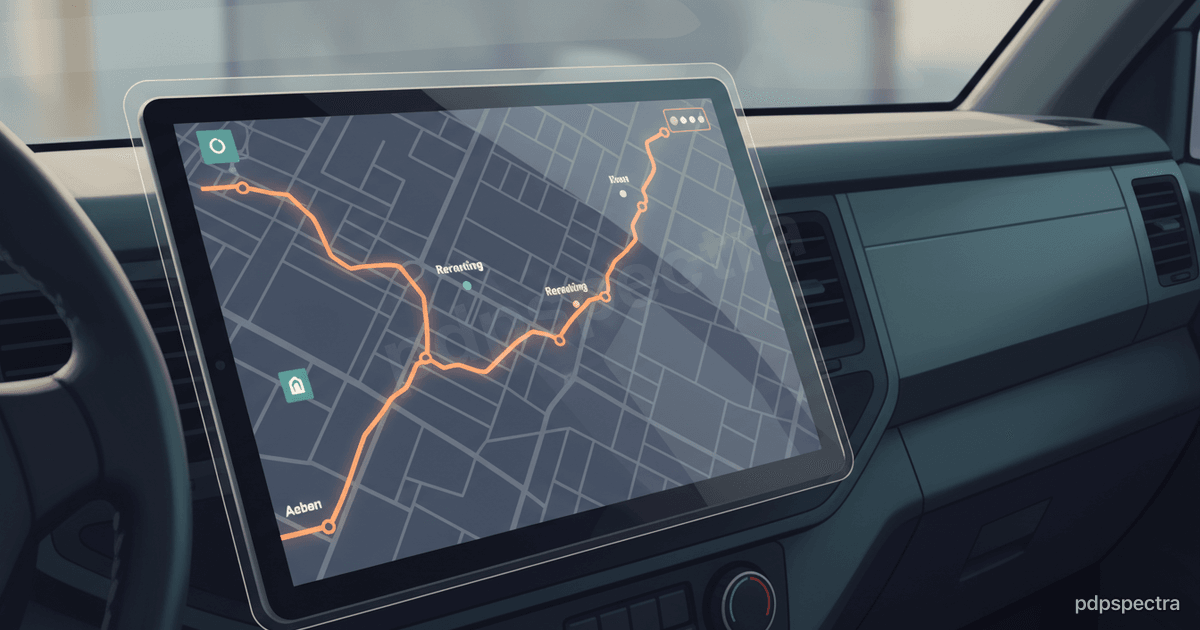
Dynamic re-routing in production#
Static planning happens overnight or in the early morning; dynamic re-routing happens through the day as plans collide with reality. The 2026 production state of dynamic re-routing is mature for several categories:
Delivery exception handling — when a customer is not available, when an address is wrong, when a stop takes much longer than expected — the system rebalances the remaining route in near real time.
Real-time order injection — same-day and on-demand orders that arrive after the initial route plan are slotted into existing routes when feasible or assigned to a new driver.
Disruption response — traffic incidents, weather events, vehicle breakdowns trigger broader rebalancing across affected routes.
The hard part of dynamic re-routing is not the optimization math; it is the operational acceptance. Drivers need their plan to be stable enough to execute. Customers expect ETAs that do not whipsaw. Dispatch supervisors need to know what is being changed and why. Mature deployments tune the dynamic adjustment frequency carefully to balance optimization gains against operational noise.

EV fleet routing as a step-change constraint#
Electric vehicles have introduced a routing constraint that legacy diesel-fleet optimization simply did not have to model — range. Range is itself a function of payload, ambient temperature, route topology (hills are expensive on EVs in both directions), driver behavior, and battery age.
EV routing requires the optimizer to model state-of-charge through the route, plan charging stops where necessary, account for charging station availability and downtime, and consider the time cost of charging (which can be 30 to 60 minutes for fast-charge depending on infrastructure). Several vendors have built explicit EV routing modules — Wise Systems, Geotab’s EV products, Samsara’s EV-specific features, and the routing tools from the major EV truck OEMs (Daimler, Volvo, Tesla Semi where deployed).
The honest 2026 state of EV fleet routing is that mixed-fleet operations are messier than the marketing suggests. EVs perform well on predictable urban delivery routes where the daily distance fits comfortably within range and depot charging works. They perform less well on variable long-haul routes and on routes where temperature extremes or terrain unexpectedly degrade range. The optimizer needs to be honest about EV uncertainty rather than treating range as a hard parameter.
The data engineering substrate#
The under-told story of modern route optimization is the data engineering. The optimizer is only as good as its inputs:
Service-time models per stop type, refreshed continuously from actual performance. Speed and travel-time matrices that reflect actual road conditions rather than posted speeds. Time-window compliance rates per customer that inform appetite for risk. Driver performance models that capture real differences in route execution.
The vendors that win in 2026 are the ones whose data substrate is in good shape; the optimization math is increasingly a commodity.
Where the gaps remain#
Cross-fleet optimization across third-party carriers (the brokerage or shared-fleet pattern) remains harder than single-fleet optimization because the data sharing and commercial structure resist tight integration. Final-mile and middle-mile optimization are often optimized separately when they should be optimized together. Reverse logistics (returns) is poorly integrated into most route plans.
Where pdpspectra fits#
Our data engineering practice and AI integration practice help logistics operators, 3PLs, and field service companies build the data substrate, integrations, and decision systems that production route optimization actually requires.
Related reading: AI fleet routing beyond OR-Tools, fleet tracking six weeks buyers guide, and TMS-agnostic logistics data platforms.
Route optimization is mature, the inputs are richer, and EV adds a real constraint. Talk to our team about your routing and dispatch systems.