AI in Mental Health Tech 2026: Woebot, Wysa, Lyra, Spring Health
Mental health AI in 2026 — Woebot, Wysa, Lyra, Spring Health, Headspace. Employer benefits, regulation post-Replika and character.ai, ethical guardrails.

A software engineer in Manchester opens Wysa on the bus home after a tense day. She types three sentences about workplace anxiety. The bot responds with a cognitive-reframing exercise, then suggests booking a session with one of her employer-benefits-funded therapists for the following week. She does. A month later she has a clear care plan, has used the app daily, and has had four therapist sessions billed through her employer’s mental-health-tech vendor. This is the modal 2026 mental-health-tech user journey, and the vendor stack that supports it is now a multi-billion-dollar industry.
The mental-health technology landscape has matured, consolidated, and been pushed into a more serious regulatory posture by the late-2024 wave of consumer-AI-chatbot harm cases (the Character.AI lawsuits, the Replika regulatory actions in Italy, the suicide-pact-style cases that made headlines). The legitimate clinical-tech vendors are now markedly different from the consumer companion-AI products that share some surface features, and the boundary is finally being drawn — by regulators, by employers, and by clinical bodies.
The clinical-tech vendor landscape#
Woebot Health anchored the original chatbot-based CBT model — a structured cognitive-behavioural-therapy chatbot designed by clinical psychologists, with multiple peer-reviewed efficacy studies. In 2024 they shifted to an enterprise-only model after winding down the consumer app. The clinical evidence base and the explicit boundary (it is a CBT-style coaching tool, not a substitute for therapist) remained the strategic distinction.
Wysa sits as the largest global player in conversational mental-health support — strong international footprint, ISO 13485 and SOC 2 certifications, integrations with NHS and several large employer benefits programmes. The model is rule-and-protocol-anchored with selective generative-AI components for natural conversation, deliberately bounded.
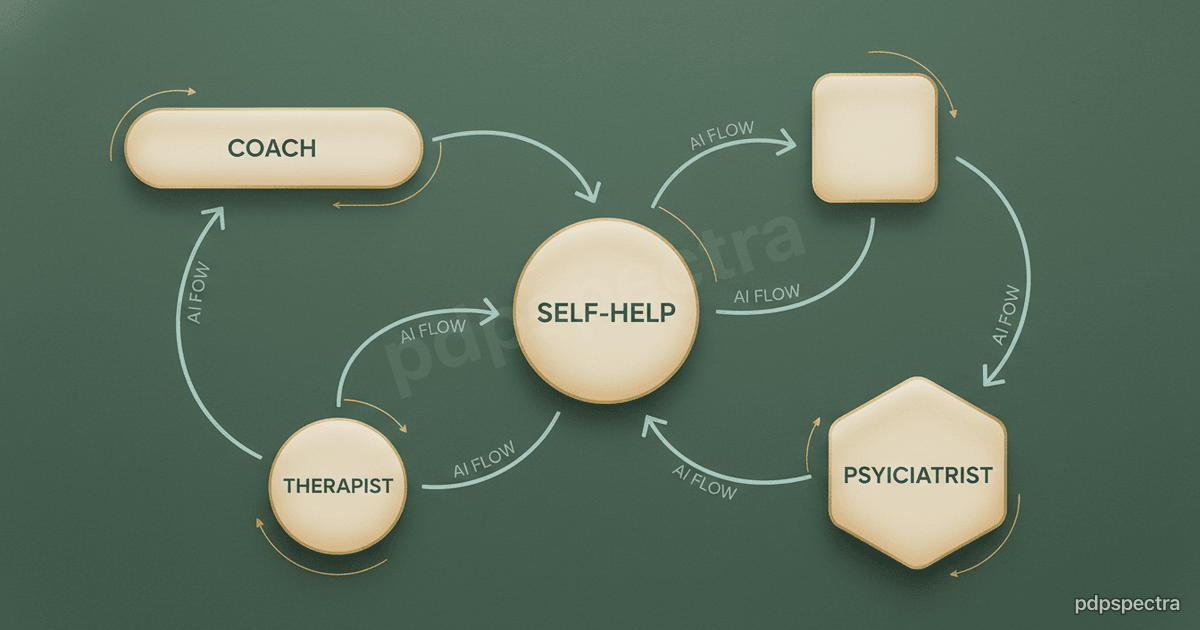
Lyra Health is the US employer-benefits heavyweight — providing a stepped-care model from self-guided digital content through coaches to licensed therapists, with AI in care navigation, triage, and clinician-side tooling. The product is sold to employers (Microsoft, Morgan Stanley, Walmart, large tech companies) as a covered benefit.
Spring Health is the closest direct competitor in the US employer-benefits space — similar stepped-care model with strong AI-driven precision-matching of members to therapists based on clinical profile and outcomes data.
Headspace (post-Headspace Health merger and recent restructuring) anchors the meditation-app-plus-clinical-services hybrid, with AI features for personalisation and increasingly for coach-side tooling.
Modern Health, Lifestance Health (with AI augmentation), Talkspace (text-first therapy with AI clinician tools), BetterHelp (under Teladoc), Big Health (Sleepio for insomnia, Daylight for anxiety — FDA-cleared digital therapeutics).
Crisis-specific tools — Crisis Text Line, Vibrant Emotional Health (988 Lifeline) — use AI in volunteer-counselor matching, message triage, and supervisor-side risk surfacing, with extremely strong safety scaffolding.

What the technical and clinical architecture looks like#
The serious clinical-tech vendors share an architecture pattern that is meaningfully different from the open consumer-chatbot products.
The system is anchored in structured clinical protocols — CBT, dialectical behaviour therapy modules, acceptance and commitment therapy, behavioural activation — that constrain the conversation paths. Generative AI handles the natural-language surface (rephrasing, follow-up questions, summarisation) but the clinical content sits inside curated protocols authored by clinical psychologists.
A risk-detection layer runs in parallel across every conversation, flagging suicide ideation, self-harm language, abuse disclosures, or eating-disorder content, with deterministic escalation paths — surface a crisis resource immediately, page a human, freeze the chat until a clinician engages. The serious vendors publish their risk-detection methodology and have audit data on false-negative rates.
The care-navigation layer — stepped-care matching, therapist-fit prediction, session-cadence recommendations — is where ML genuinely improves outcomes, by getting the right level of care to the right member at the right time. This is the pure operations-research-meets-clinical-data corner of the stack.
The clinician-side tools — session summarisation, between-session messaging triage, treatment-plan suggestions — sit alongside the therapy itself, with the human firmly in the loop.
The Replika and character.ai shadow#
The late-2024 and 2025 cohort of cases — Character.AI lawsuits over teen-suicide cases, the Italian DPA’s Replika enforcement, the multiple investigative reports on companion-AI products marketed to teens — forced regulators and the legitimate clinical-tech sector to draw clearer boundaries. The substantive issues:
- Open-ended generative AI products with no clinical protocol, no risk-detection scaffolding, and no human-in-the-loop are not mental-health tools, even when marketed as friendly listeners.
- “AI companion” products that build emotional dependency and lack crisis-escalation flows have caused documented harm.
- Disclosure that a product is not therapy, not crisis support, and not a clinician matters and is enforceable.
The legitimate clinical-tech vendors have been clearer in their marketing, documentation, and regulatory posture as a result. Several jurisdictions — California, Texas, the EU under the AI Act high-risk classification work — are moving toward explicit regulation of AI in mental-health contexts.
Integration with employer benefits and payer networks#
The dominant business model in the US is employer-paid: HR teams contract with Lyra, Spring Health, Modern Health, Headspace, or Talkspace as a covered benefit, with members getting some number of free sessions per year and a price-protected continuation path. AI is largely invisible to the member at the contract level — it is part of the operational fabric that makes the vendor’s clinical-services unit-economics viable.
Integration patterns. Single sign-on with the employer benefits-administration platform (Workday, ADP, Sequoia, employer-specific portals), member-eligibility feeds, claims and utilization reporting, and outcome metrics on PHQ-9, GAD-7, and treatment-adherence data. The vendor’s data warehouse — typically Snowflake or BigQuery — anchors the analytics, with the ML models for matching and outcome prediction sitting in the MLOps layer alongside.
In Europe and India, public-system integrations matter more — NHS Talking Therapies referrals, India’s National Mental Health Programme touchpoints — and the AI vendor must integrate with the existing referral and triage workflows rather than replacing them.
Regulation and ethics#
The FDA’s digital-therapeutics pathway is the formal route for products that make explicit therapeutic claims. Big Health’s Sleepio (insomnia) and Daylight (anxiety) are FDA-cleared examples. Most mental-health apps stop short of explicit therapeutic claims to stay in the wellness-app regulatory zone, which is meaningfully more permissive but also more contested.
Privacy is the load-bearing concern. HIPAA covers covered entities and business associates; many consumer mental-health apps historically sat outside HIPAA, which led to data-sharing practices that the FTC has begun enforcing against. State privacy laws (California CCPA/CPRA, Connecticut, Texas, Washington’s My Health My Data act) add a meaningful layer.
Where pdpspectra fits#
We help mental-health-tech vendors and employer-benefits buyers design the operational backbone — secure data pipelines, integration with HRIS and EHR systems, MLOps for the matching and outcome models, audit-grade logging, and the privacy and security posture that the regulated environment requires. See our AI and LLM integration practice.
Related reading#
- Healthcare AI playbook: pilot to production
- Voice AI in clinical documentation
- GDPR compliance for AI systems
If you are building, buying, or scaling a mental-health-tech platform and want a pragmatic read on the AI investment, ethical guardrails, and integration approach, reach out.