Auto-Framing at Speed: The AI Stack Inside Action Cameras
How action cameras run real-time tracking, pose estimation, and gimbal-free stabilization on a 2-watt SoC — and the model-compression tricks that fit.

A modern action camera is a strange piece of engineering. It is a wearable computer strapped to a helmet, asked to find a moving human in a shaking frame, keep that human centered, level the horizon against a tumbling chassis, and flag the three seconds worth keeping — all while encoding 5.3K video, sipping from a battery the size of a matchbox, and staying cool enough to wear. None of this is allowed to drop a frame.
That constraint set is, in our view, one of the more honest stress tests in applied computer vision. There is no cloud to fall back on, no GPU cluster, no second chance on a frame that has already been written. The interesting work happens in the gap between what the silicon can do and what the use case demands. This is a tour of that gap: the perception stack, the latency budget, and the compression that makes it fit.
The perception stack, in execution order#
Strip the marketing names away and every one of these cameras runs roughly the same pipeline. A detector proposes where subjects are. A tracker maintains identity across frames. A re-identification step recovers that identity after the subject leaves and re-enters the frame. Stabilization and framing consume the tracker’s output to decide what slice of sensor the viewer actually sees. A separate, lazier highlight model watches the whole thing and decides what was worth recording.
The detector is the front door. On most current action-cam silicon it is a compact single-stage convolutional network — a YOLO-family or SSD-family architecture trimmed hard for the SoC’s accelerator. The job is deliberately narrow: people, faces, sometimes animals and vehicles. You do not need eighty COCO classes on a ski slope. Narrowing the class set is the first and cheapest optimization nobody talks about, because every class you delete is feature-map capacity you reclaim for frame rate.
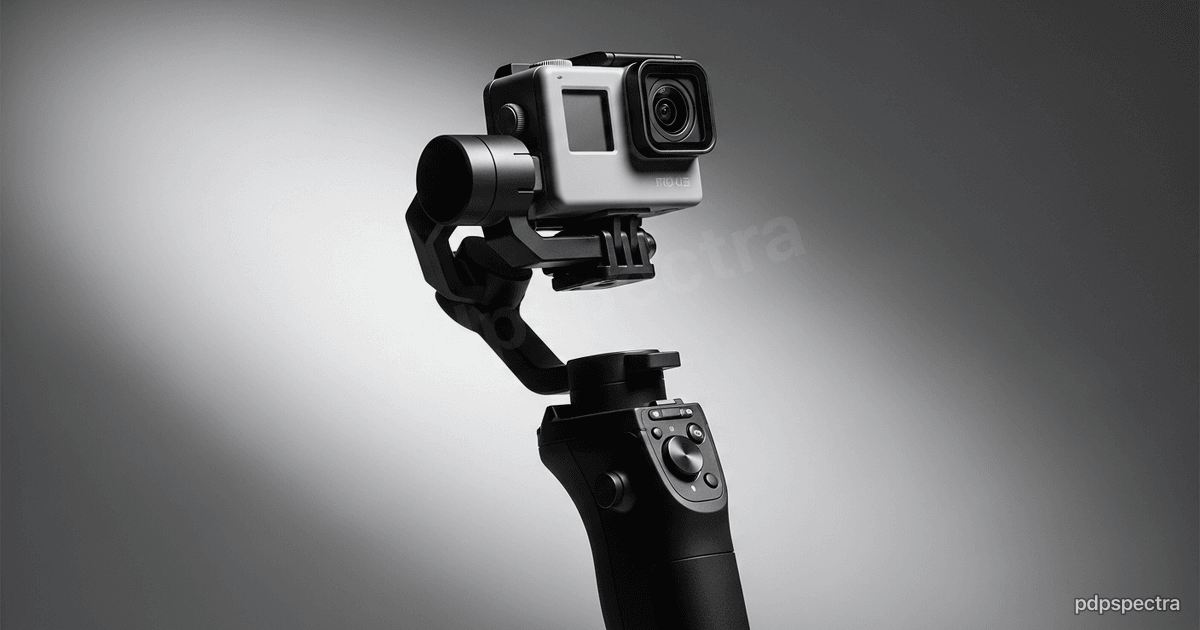
Detection is expensive, so you do not run it every frame. The standard pattern is detect-then-track: run the heavy detector on a keyframe cadence, then hand off to a cheap single-object tracker that updates between detections using correlation or a lightweight regression head. Insta360’s Deep Track and DJI’s ActiveTrack are productized versions of exactly this loop — lock a box, follow it, periodically re-confirm. The tracker is what keeps the green box glued to a snowboarder while the detector takes a breather.
Re-identification is where the demos break#
Single-object tracking is easy until the subject is occluded. A tree passes in front of the rider. Two athletes cross. The tracker, which only knows appearance and motion continuity, happily latches onto the wrong body. This is the failure every casual demo hides and every real deployment has to solve.
The fix is re-identification: an embedding model that turns a crop of the subject into a vector, so that when a candidate re-enters the frame you match on identity rather than position. Insta360 markets this directly as Person Re-Identification within Deep Track, claiming the system holds the same person through occlusion and recovers them when they reappear. DJI’s ActiveTrack 7.0 added registered-subject priority, pre-enrolling a handful of faces so the system has a target identity before tracking even starts. That is a re-ID gallery by another name.
The engineering tension is that a good re-ID embedding wants a deeper network than the SoC wants to run. So the embedding gets computed sparingly — on detection keyframes, not every frame — and cached. The tracker carries the cheap motion model in between. This is the recurring shape of the whole system: do the expensive, accurate thing rarely, and interpolate cheaply in the gaps.
Pose, for the sports that need it#
For sports analytics and certain framing modes, a bounding box is not enough — you want the skeleton. Pose estimation puts keypoints on shoulders, hips, knees, ankles, and that joint graph is what lets a system reason about a body’s orientation, not just its location. It is the difference between knowing a gymnast is in the frame and knowing they are inverted mid-flip.
On-device pose is its own cost center. Top-down approaches detect the person, then run a pose net on the crop — accurate, but the cost scales with the number of subjects. Bottom-up approaches find all keypoints in the frame and group them afterward — flatter cost, messier grouping. On a thermally constrained chassis, single-subject top-down is usually the pragmatic call, because action framing only cares about one body anyway. The skeleton also feeds framing heuristics: lead the frame in the direction the body is facing, keep headroom above the head keypoint, tighten on the torso when the limbs flail.
This is not exotic computer vision reserved for cameras. The same single-subject pose pipeline underwrites clinical motion analysis — the kind of gait and range-of-motion tracking that a Hospital Management System module might surface for a physiotherapy ward — and campus-safety analytics in a School ERP. The domain changes; the load-bearing math does not. That portability is the whole argument for building the plumbing well once.
Gimbal-free stabilization and the horizon problem#
Stabilization is the feature that made action cameras tolerable to watch, and it is mostly not AI — which is exactly why it is worth dwelling on. GoPro’s HyperSmooth and its peers are electronic image stabilization: the sensor captures wider than it outputs, an integrated gyroscope streams angular motion, and the algorithm crops a stabilized window out of the oversized frame, shifting and rotating that window frame-by-frame to cancel the measured shake. No motors. The cost is sensor margin you give up to the crop and the compute to warp every frame.
Horizon leveling rides the same gyroscope. Once you know the camera’s orientation in world space, you rotate the output window to keep the horizon flat even as the body rolls. The hard part is not the rotation; it is the sensor fusion. Gyroscopes drift, accelerometers are noisy under the very high-G chaos of action use, and you are fusing them in real time with a tight latency tolerance. Get the fusion wrong and the horizon swims — the uncanny, seasick artifact that betrays a weak implementation.
Here is the architectural point worth internalizing: stabilization is a sensor-fusion and signal-processing problem wearing a computer-vision costume. The neural network is not the load-bearing element. The gyroscope timestamping, the rolling-shutter correction, and the fusion filter are. A team that reaches for a transformer here has misread the problem.
The edge-inference reality: the budget is everything#
Now the constraint that governs all of it. At 60 frames per second your entire per-frame budget is under 17 milliseconds, and inference is only a slice of it — the ISP, encoder, and stabilization warp all need their cut. The model does not get the whole frame interval; it gets a few milliseconds, and it must hit that ceiling every single frame, not on average. Tail latency is the spec. A model that is fast on average but stalls one frame in fifty produces visible judder, and judder is the thing the product exists to eliminate.
This is why the silicon matters more than the model zoo. Ambarella’s CVflow architecture is built around a dedicated neural accelerator, and the company states the CV5 encodes 8K at 30fps while drawing under 2 watts — the power envelope, not the raw throughput, is the headline number. Qualcomm pushes the same story from the mobile side with dedicated NPU blocks. On these parts you are not running whatever PyTorch produced; you are running what the vendor’s compiler could map onto the accelerator’s supported operator set. Ambarella ships a toolchain that ingests ONNX, PyTorch, and TensorFlow graphs precisely because the gap between a trained model and a deployable one is where projects die.
Making it fit: quantization, pruning, distillation#
Three techniques close the gap between a research model and one that survives the thermal budget, and any serious deployment uses all three together.
Quantization is the first and biggest win. You take a network trained in 32-bit float and run it in 8-bit integer, because the accelerators are built for integer math and integer arithmetic is faster and far more power-efficient. Done as quantization-aware training rather than naive post-training conversion, INT8 detectors hold accuracy within a hair of their float originals. On an action cam, the power saving is not a nicety — it is the difference between a feature that runs and one that throttles after four minutes.
Pruning removes the network’s dead weight. Structured pruning drops whole channels and filters, which is what you want on this hardware because the result stays dense and predictable — it maps cleanly onto the accelerator instead of producing sparse matrices the silicon cannot exploit. A correctly pruned detector is smaller, cooler, and crucially, more consistent in its per-frame timing.
Distillation is how you keep accuracy while shrinking. Train a small student network to imitate a large teacher’s outputs, and the student often beats the same architecture trained from scratch on labels alone. In practice these compose: prune, then apply quantization-aware training, then distill from a full-precision teacher — a standard combined pipeline for on-device vision.
Highlights, and the case for doing less#
The last model in the stack is the laziest by design. Highlight detection — GoPro’s HiLight tagging is the consumer face of it — does not need to run at frame rate. It watches for signal: a spike in motion, a recognized face, a scene change, sometimes audio energy. It can run on a downsampled stream, batch its work, and tolerate latency the tracker never could. Recognizing that not every model in the system shares the same latency class is itself an optimization. You spend your millisecond budget where the eye is watching and let everything else run slow.
That is the worldview we bring to edge work generally. A latency budget is a data problem before it is a model problem — what you sample, when, at what resolution, and how you fuse it. The teams that ship build the plumbing first: sensor timestamping, keyframe scheduling, the quantization pipeline, operator coverage. Then they pick the smallest model that clears the bar and stop. The trendy architecture that needs an operator the accelerator does not support is a rewrite waiting to happen. Cut it, keep the load-bearing tools. That discipline holds whether the target is a helmet camera, an Operational Automation deployment on a factory line, or an AI implementation feeding real-time Data Platforms. The constraint teaches the architecture.
Build the budget before you pick the model — if it does not clear tail latency every frame, it does not ship. Talk to pdpspectra about edge inference under real constraints.