Superconducting and Cryogenic Compute for AI
SFQ logic and cryo-CMOS promise orders-of-magnitude energy gains for AI compute. The honest engineering case — and the cooling-overhead counterargument.

Most of the hardware conversation around AI energy is incremental — a better cold plate, a denser package, a more efficient power-delivery network. Superconducting and cryogenic compute is the opposite: a proposal to change the physics the logic runs on. The pitch is enormous energy efficiency. The counter-pitch is that you have to refrigerate the whole thing to a few degrees above absolute zero, and that refrigeration is brutally expensive. This post lays out the real engineering case on both sides, grounded in what the research actually shows, and is honest about how early all of it is.
Two different ideas, often conflated#
“Cryogenic compute” gets used loosely for two distinct technologies. Keep them separate or the argument falls apart.
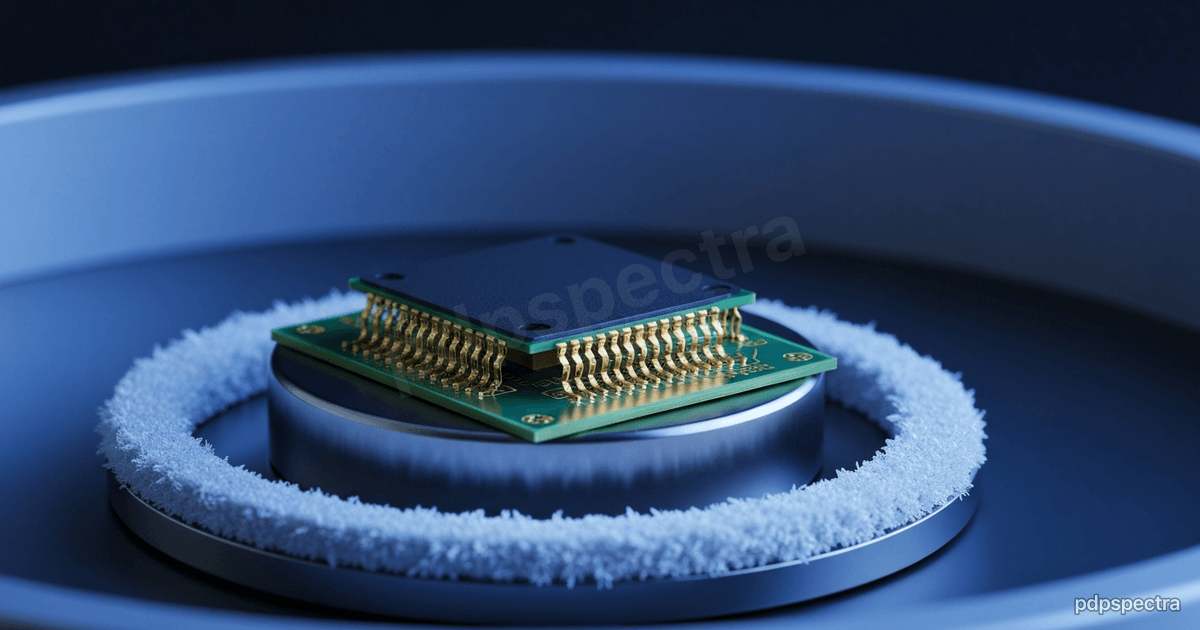
Cryo-CMOS is ordinary silicon CMOS — the same transistors in your GPU — run cold. Cool a chip and electrons scatter less, carriers move faster, leakage drops, and you can either go faster at the same power or run far cooler at the same speed. Georgia Tech researchers characterized 14nm FinFET CMOS from room temperature down to 4 Kelvin and found the gains real but temperature-dependent. The semiconductor stays the same; only the operating point changes.
Superconducting logic is a different device family. Single-Flux-Quantum (SFQ) logic — and its low-power descendants — represents bits not as voltage levels but as tiny quantized magnetic flux pulses moving through Josephson junctions. There is no resistance and effectively no static power. Each switch dissipates almost nothing. This is not cold silicon; it is a different way to compute that only exists below the superconducting transition temperature.
The energy argument#
The headline numbers for SFQ are genuinely startling. A single bit-switch in an energy-efficient RSFQ device dissipates on the order of 2×10⁻¹⁹ joules with zero static power dissipation. That is several orders of magnitude below the switching energy of state-of-the-art CMOS — and the research community’s claim is that it stays orders of magnitude better even after you account for the cooling cost down to 4.2 K. Zero static power is the part worth dwelling on: a huge fraction of a modern chip’s energy is leakage in idle transistors. SFQ doesn’t leak. Nothing flows when nothing is switching.
Cryo-CMOS is more modest but more believable, because it’s incremental on a mature technology. At 77 K — liquid-nitrogen temperature — CMOS shows roughly a 7x power advantage at the same frequency versus room temperature. But — and this is the entire fight — once you charge that advantage for the energy spent cooling, the net drops to about 4x. Still a real gain. Not the headline.
The mechanism behind the cryo-CMOS gain is worth understanding because it bounds how far it goes. Two things improve as silicon cools: carrier mobility rises, so transistors switch faster at a given voltage, and subthreshold leakage falls sharply, so idle transistors waste less. The leakage win keeps improving almost linearly as you go colder, but the mobility and switching win saturates — past a point, more cold buys you very little extra speed while the cooler keeps costing more. That is why the analyses converge on a sweet spot well above 4 K. You are not chasing absolute zero; you are chasing the temperature where the marginal device gain still beats the marginal cooler cost. For CMOS that point is warm by cryogenic standards.
The cooling-overhead counterargument#
Here is the counterargument every credible analysis runs into, and it is not subtle: refrigeration to cryogenic temperatures is governed by thermodynamics that punishes you hard as you go colder.
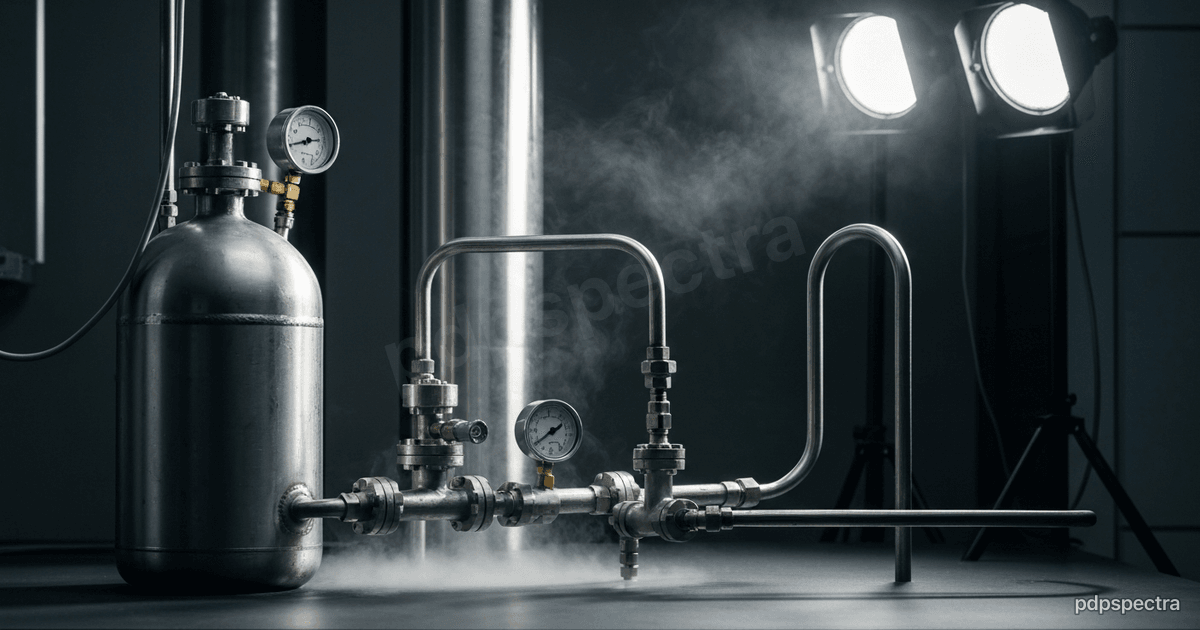
Removing one watt of heat at 4 K and rejecting it to a room-temperature environment costs far more than one watt of input power — the Carnot penalty alone is steep, and real cryocoolers fall well short of Carnot. The best high-capacity 4 K cryocoolers relevant to serious compute achieve efficiencies on the order of below 400 watts of input per watt removed — a Linde LR280 sits around 360 W/W. Read that again: to pull a single watt of heat out of a chip at 4 K, you spend hundreds of watts running the fridge. Any device living down there has to be hundreds of times more efficient than its warm equivalent just to break even at the wall.
That math is exactly why the interesting operating point may not be the coldest one. The cryo-CMOS analyses suggest optimal efficiency lands somewhere between 100 K and 150 K, with the practical benefit saturating around 200 K — temperatures where the cooler overhead is far gentler. The deepest cold is reserved for the devices that have no choice but to be there: superconductors, whose entire value proposition only exists below their transition temperature, where they can plausibly justify the fridge.
There’s a second overhead that rarely makes the slides. A cold compute core still has to talk to a warm world. Control, clock and bias distribution, and the wiring between temperature stages all carry their own system-level cost — and for cryo-CMOS control circuitry the per-element dissipation can be milliwatt-class, which adds up fast inside a tight cooling budget. The wires that cross the temperature boundary leak heat inward. The thermal accounting has to include all of it, not just the logic.
This is the trap in every optimistic projection: it benchmarks the logic in isolation and quietly omits the system around it. A device that switches at 2×10⁻¹⁹ joules looks miraculous on its own and merely interesting once you add the cooler, the cryostat wiring, the warm-side controllers, and the heat those interconnects drag in. The number that matters is the one measured at the utility meter feeding the whole installation, doing useful work — and that number is always larger, sometimes by enough to erase the advantage entirely. Anyone selling cryogenic compute on a per-switch figure is selling you the best slide, not the system.
How early is this, really#
Honest answer: early, and unevenly so.
Cryo-CMOS is the nearer-term of the two and even it is mostly lab and specialized work. The most active near-term driver isn’t AI at all — it’s quantum computing, which needs cold classical control electronics sitting next to the qubits, and companies like SemiQon have demonstrated CMOS transistors built to operate at cryogenic temperatures. That ecosystem could spill useful technology into AI, but “could spill over” is not a deployment plan.
Superconducting SFQ logic is further out for general-purpose compute. The energy numbers are real and have been for years; the gap is everything around them — design tools, memory (superconducting memory remains a genuinely hard, unsolved-at-scale problem), fabrication maturity, and integrating a cryogenic island into a data center that is otherwise air and water. There is no SFQ AI accelerator you can buy and rack today. Treat anyone who implies otherwise with suspicion.
The memory problem deserves its own line because it is the quiet killer. Compute that doesn’t leak is useless if it has to stall constantly waiting on data, and a dense, fast, energy-efficient superconducting memory at scale does not yet exist. Without it, an SFQ logic core spends its time talking to warm DRAM across a temperature boundary — and every one of those crossings carries the system-level and thermal overhead described above. The research community is candid about this: the logic is the easy part. The memory, the clocking, and the interconnect between the cold core and the warm world are where the open problems live, and they are not close to solved. Some of the most interesting recent work isn’t even aimed at general AI — it is neuromorphic, mapping spiking networks onto SFQ pulses, where the pulse-based nature of the logic is a natural fit rather than a forced one.
What an engineering team should actually do#
Nothing operational, yet — and that’s the correct call, not a hedge. For any near-term AI build, the energy levers that pay off are the boring ones: right-sizing accelerators to the working set, real liquid cooling, scheduling and utilization, and an honest PUE. We’ve watched more energy saved by killing idle GPU allocations through better Operational Automation than any exotic device would have delivered, and that holds whether the workload is a Data Platform, a School ERP, or a clinical model behind a Hospital Management System.
Where this belongs is on the watch-list, tracked with discipline. The signal to watch is not a flashy efficiency claim about the logic in isolation — those have existed for a decade. It is total system efficiency at the wall, cooling included, demonstrated on a real workload. The day someone shows a net energy win on an AI task after paying the full cryogenic tax, the conversation changes. Until then, superconducting and cryogenic compute is one of the most physically interesting bets in hardware and one of the least ready to deploy — and saying both at once is the only honest position.
Want a clear-eyed read on emerging compute before you bet a roadmap on it? We separate the physics from the marketing. Talk to our team.