AI in Travel Booking 2026: Booking.com's Trip Planner, Expedia's Romie, and the Agentic Trip Thesis
Where AI lives in travel booking in 2026 — Booking.com AI Trip Planner, Expedia Romie, Kayak's AI search, Hopper, Mindtrip, Layla, and the agentic trip planner thesis that GDS integration both enables and limits.

Travel was one of the first consumer applications of generative AI to ship in scale. Within twelve months of ChatGPT’s launch, every meaningful OTA, metasearch site, and several startups had a “chat with AI about your trip” feature. By 2026 the gap between the chat-with-AI demo and a trip that actually books has narrowed but not closed, and the agentic trip planner thesis — an AI that researches, books, and pays end-to-end — is closer than it was but still not a default consumer experience.
This is the state of AI in travel booking in 2026, what the named products do, and where the GDS integration layer both enables and limits what is possible.
The OTA majors: Booking and Expedia#
Booking.com’s AI Trip Planner launched in beta in 2023 and became more broadly available across 2024 and 2025. The product allows natural-language conversation about destinations, dates, and preferences, surfacing properties from Booking’s inventory and increasingly flights and experiences. Booking has been comparatively conservative about agentic booking — the AI assists discovery and itinerary building; the human still confirms the booking through the standard funnel.
Expedia’s Romie is the more ambitious agentic concept. Romie operates across the trip lifecycle — research, group planning, on-trip updates, post-trip changes — and is positioned as a continuous travel companion rather than just a search interface. Expedia has integrated Romie deeply with their inventory across hotels, flights, cars, and packages, and has been more willing than Booking to push toward AI-driven booking actions with appropriate confirmation gates.
Tripadvisor’s AI Trip Builder and Trip.com’s TripGenie round out the major OTA AI products. Each is variations of the same theme — conversational discovery, itinerary generation, integration with native inventory.
The honest competitive read in 2026 is that the OTA majors have neutralized the early threat from pure-play AI startups by integrating their AI into the funnel customers already use. The startups that survived had to find a different angle.
Metasearch and the Kayak position#
Kayak’s AI search (the OpenAI-powered ChatGPT plugin was an early implementation, since followed by deeper integration) is the metasearch take on AI booking. Kayak’s position is structurally interesting because they aggregate across OTAs and direct airline and hotel sites rather than owning inventory, which means the AI can compare across sources in a way an OTA’s native AI cannot.
Skyscanner’s AI features and Hopper’s price prediction are the other notable metasearch and price-prediction tools. Hopper in particular has been one of the more interesting product trajectories — what started as a flight-price-prediction app has become a fintech business as much as a travel one, with travel insurance and price-freeze products that are essentially derivatives.
The AI-native startups: Mindtrip, Layla, Wonderplan#
The 2023 to 2024 wave produced several AI-native trip planning startups. Mindtrip (originally from the team behind Klar and earlier travel tech) built a more visual, exploratory trip planning experience with AI at the core and partnerships with several inventory providers. Layla (formerly Beautiful Destinations) leaned into Instagram-style inspiration combined with AI itinerary building. Wonderplan, Roam Around, and a long tail of others occupy adjacent niches.
The honest 2026 read on this segment is that the startups that survived found a discovery-and-inspiration angle rather than competing head-on with OTAs on the transactional booking flow. Pure-play AI booking startups have mostly either pivoted, been acquired, or quietly shut down — the economics of paid acquisition in travel are unforgiving, and the OTAs control the inventory and pricing relationships that make the booking flow possible.
The agentic trip planner thesis#
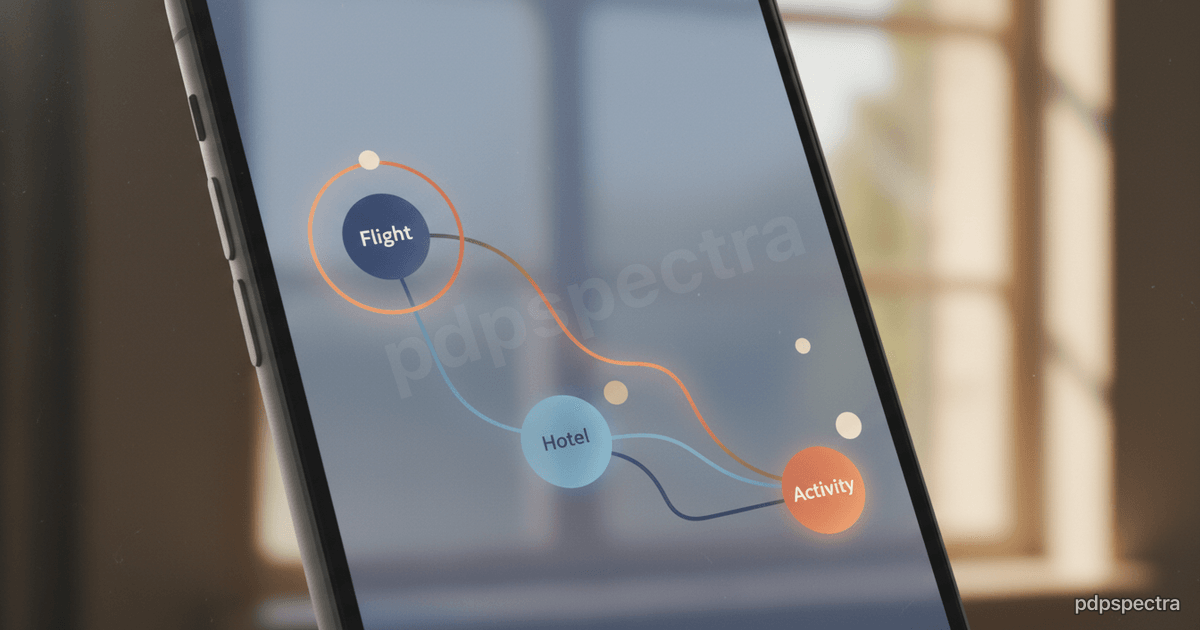
The thesis is that an AI agent will research, plan, book, and manage a trip end-to-end with minimal human intervention beyond stating intent. By 2026 there are working demos of this — most published demos use a combination of LLM reasoning, a tool layer (browser automation or API calls), and inventory access through partnerships.
The honest gating constraints are not primarily technical. They are commercial and trust-based. Airlines and hotels do not want to be commoditized by an agent that books on the user’s behalf without surfacing brand differentiation. Payment networks have settlement and chargeback issues with agent-initiated transactions. Users are reluctant to authorize an agent to spend several thousand dollars on a trip without confirmation. Regulators in the EU and several US states have started asking questions about AI-mediated commerce and disclosure.
The realistic 2026 state of agentic trip planning is that the agent does research and proposes; the human confirms. The fully autonomous booking agent will continue to exist in demos but is not the default consumer experience.

The GDS layer: Sabre, Amadeus, Travelport#
Every flight that books through an OTA or a corporate travel platform touches a GDS — Sabre, Amadeus, or Travelport. These three platforms intermediate inventory between airlines and the booking layer, and they are where the actual ticketing and PNR (passenger name record) creation happens.
The GDS layer is both an enabler and a constraint for AI booking. Enabler: standardized APIs (in 2026 mostly NDC-based for new integrations, with the legacy EDIFACT layer still present), broad inventory, and well-understood fare construction rules. Constraint: NDC adoption is still uneven, content gaps remain for certain ancillaries, and the latency of fare and availability calls is meaningful for an interactive AI experience.
Amadeus has invested heavily in AI-friendly APIs and developer experience, with Amadeus for Developers exposing flight search, hotel search, points of interest, and trip planning building blocks. Sabre has been similar with Sabre Dev Studio. Travelport+ is the third major option.
For OTAs and AI trip planners building real booking flows, the GDS integration work is unglamorous, unavoidable, and is where most of the actual engineering time goes — not in the LLM prompt design.
Corporate travel and the TMC layer#
The corporate travel segment has different dynamics. Concur (SAP Concur), Navan (formerly TripActions), Egencia (American Express GBT), and TravelPerk are the major travel management companies and platforms. Each has layered AI into booking, policy enforcement, and expense workflows.
The notable shift in 2024 and 2025 was Navan’s aggressive push toward agentic trip changes (rebooking when flights cancel, finding alternatives during disruption) and toward conversational expense and policy queries. The corporate segment is in some ways a faster mover than consumer because the buyer (the corporate travel manager) wants the friction reduction and the user (the traveler) has explicit policy guardrails that constrain the agent’s autonomy in productive ways.
Where the gaps remain in 2026#
Group and multi-traveler bookings remain harder than the marketing implies. Trip modification mid-journey is partially handled. Loyalty and points redemption is a known weak spot — AI agents struggle to optimize award space because the underlying availability is itself a hard combinatorial problem and is gated by airline and hotel commercial decisions.
The other honest gap is the trust and disclosure layer. When an AI recommends a property, the user does not always know what commercial relationship is informing the recommendation. The OTAs have been more careful about this than the AI-native startups, partly because the OTAs have lived through years of regulatory attention on ranking transparency.
Where pdpspectra fits#
Our AI integration practice helps OTAs, metasearch sites, and corporate travel platforms build production AI booking experiences — GDS integration, prompt and tool design, evaluation harnesses, and the booking flow plumbing that makes the AI demo into a real product.
Related reading: travel tech APIs Sabre, Amadeus, direct, AI agent orchestration patterns, and AI customer service helpdesk 2026.
Travel AI is real, mostly integrated into existing OTAs, and agentic booking is closer than it was but not the default. Talk to our team about your travel booking AI roadmap.