AI Voice Agents in 2026: Bland, Vapi, Retell, Sierra, and the Inbound-Call Reality
Where AI voice agents sit in 2026 — Bland.ai, Vapi, Retell AI, Sierra, PolyAI, Cresta, the inbound-call replacement reality, and the ASR-LLM-TTS stack underneath.

The AI voice-agent category got real in 2024, scaled in 2025, and by 2026 has settled into something close to the contact-centre shape that the industry has been predicting since the first IVR system. Voice AI vendors handle a meaningful percentage of inbound calls at companies that have committed to the technology, the unit economics have flipped favourably against offshore call-centre seats, and the platform layer underneath — ASR, LLM, TTS, telephony orchestration — has converged on a small group of providers.
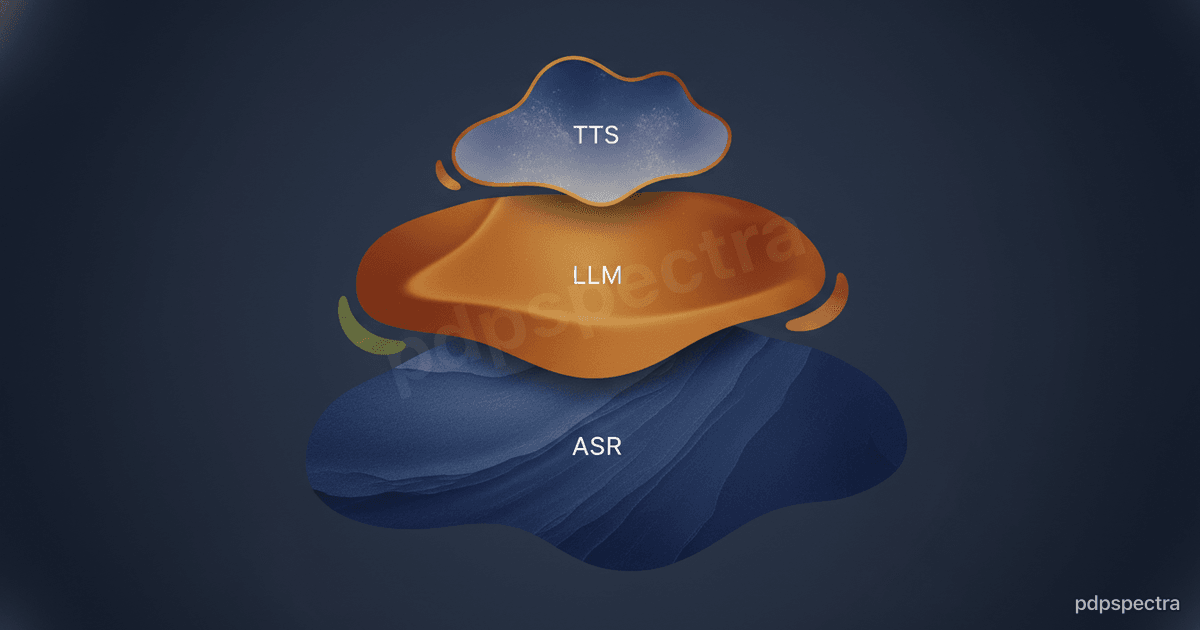
This post walks through the 2026 enterprise voice-agent landscape, the inbound-call replacement reality, the latency and interruption-handling problems that determine whether a deployment actually works, and the technology stack underneath all of it.
The application layer — Bland, Vapi, Retell, Sierra, PolyAI, Cresta#
Bland.ai, founded in 2023, has become one of the loudest voice-agent platforms in the market, positioning around the high-volume outbound and inbound use case with aggressive per-minute pricing. The product is a developer-first API for building voice agents, with the telephony, the orchestration, and the model routing handled inside the Bland stack. Their 2025 announcements around “Conversational Pathways” — essentially graph-structured conversation flows with LLM-driven node transitions — became the de facto pattern for building reliable voice agents that do not lose their way mid-call.
Vapi, founded in 2022 and Y Combinator-backed, is the developer-platform competitor that aims at builders who want lower-level control over the ASR, LLM, and TTS choices, with strong support for swapping providers and tuning latency. Retell AI sits in similar territory with a focus on the contact-centre integration story — connecting voice agents to existing CRM and helpdesk stacks rather than asking customers to rebuild from scratch.
Sierra, founded by Bret Taylor (former Salesforce co-CEO, OpenAI board chair) in 2023 and now one of the highest-valued private companies in enterprise AI, took a different positioning. Sierra is an end-to-end agent platform — not just voice, but voice plus chat plus email — that is sold to large enterprises as a managed product rather than a developer API. The Sierra deployments at companies like SiriusXM, Sonos, and ADT replace front-line customer-service tiers wholesale. The price point is enterprise, the implementation is consultant-heavy, and the resulting agents are heavily customised per customer.
PolyAI, the UK-based long-runner in the category, continues to win on the voice-quality and conversational-naturalness dimensions and has scaled into hotel reservations, restaurants, and consumer-banking inbound. Cresta, which started as an agent-assist product helping human agents during calls, has expanded into fully-autonomous voice agents while keeping the agent-assist business as a complementary product.
Vacasa, the canonical large deployment#
A small number of public deployments have become the canonical references for what a real voice-agent rollout looks like at scale. Vacasa, the vacation-rental management company, is one of them. By 2025 Vacasa’s voice operations had moved the bulk of routine inbound calls — booking changes, check-in details, basic service requests — to AI agents, with human escalation reserved for genuine exceptions. The numbers Vacasa has publicly shared suggest the operating cost per call fell by an order of magnitude against the previous offshore contact-centre baseline, with customer-satisfaction scores holding flat or improving on the call types the agents handle.
The Vacasa pattern, which other large deployments have followed, is to start with a narrow band of call types (twenty percent of volume, picked for high frequency and low complexity), prove the unit economics and the CSAT impact, and then expand the band over twelve to eighteen months.
The inbound-call replacement reality#
The honest framing of where voice agents sit in 2026 is that they handle a meaningful share of inbound calls at companies that have committed to the technology, but they do not handle all calls and they are not trying to. The deployments that work follow a triage pattern. The agent answers, identifies the caller and the intent, handles the call directly if it falls within the agent’s scope, and transfers to a human if the call is complex, the caller is upset, or the intent is outside the agent’s training. The handoff is the hard part. A bad handoff — where the human picks up with no context and the caller has to re-explain — is worse than no agent at all.
The categories where voice agents have settled in are appointment scheduling and confirmation, order status and tracking, basic account servicing (password resets, balance queries, statement requests), reservation changes, and inbound sales qualification. The categories where they have not displaced humans are genuine complaints, multi-turn complex troubleshooting, anything requiring real-time access to systems the agent has not been wired into, and anything where the caller is emotionally distressed.
The latency and interruption-handling problem#
The technical difficulty in voice agents is not the language understanding. It is the latency, the interruption handling, and the turn-taking model. A natural human conversation runs with sub-200-millisecond gaps between turns and frequent overlapping speech. Voice agents that take a full second to respond, or that cannot tolerate the caller interrupting, feel obviously robotic regardless of how good the language model underneath is.
The 2024 OpenAI Realtime API and the equivalent Gemini Live release fundamentally changed this problem by collapsing the ASR-LLM-TTS pipeline into a single streaming model with end-to-end latency well under a second. Anthropic’s real-time previews followed in 2025. The downstream vendor stacks — Bland, Vapi, Retell — built on top of these realtime APIs or on equivalent open-source approaches, and the gap between a well-built voice agent and a human agent on the latency dimension closed to the point where most callers do not notice they are talking to a machine on the first two or three turns.
The remaining latency budget gets spent on the function-calling round trips — when the agent has to look up an account in a CRM, query an order-management system, or check a knowledge base. Those external calls add 100 to 300 milliseconds each, and the agents that feel best have aggressive pre-fetch and parallel-call patterns to keep the perceived latency low.

The infrastructure layer — Deepgram, Cartesia, ElevenLabs#
Underneath the application platforms sits a stack of infrastructure providers that have become the default building blocks. Deepgram dominates the streaming ASR layer for English-first enterprise voice — the Nova-3 release in 2025 set the industry latency and accuracy bar, and most of the application-layer vendors run their default English ASR on Deepgram or on the equivalent OpenAI gpt-4o-transcribe. AssemblyAI sits in adjacent territory with strength on multilingual coverage.
Cartesia has emerged as the leader on cost-effective streaming TTS, with the Sonic model achieving voice quality close to ElevenLabs at a fraction of the per-character cost and lower latency on first-token. ElevenLabs continues to lead on voice quality, expressiveness, and the voice-cloning capabilities that matter for branded enterprise voices. The split that has settled by 2026 is that high-volume back-of-house voice agents tend to run Cartesia, while front-of-house consumer-facing agents where brand voice matters run ElevenLabs.
The LLM layer is the most fluid. The realtime APIs from OpenAI, Google, and Anthropic dominate the highest-quality tier; the application-layer vendors increasingly route between providers based on cost, latency, and the specific conversation type.
What this means for buyers in 2026#
If you are evaluating voice agents in 2026, the calculus is reasonably settled. Pick a narrow band of inbound calls where the call structure is repetitive and the handoff is graceful when things go off-script. Start with one of the platform vendors rather than building from scratch on the realtime APIs — the orchestration, telephony, and observability work is not where you should be spending engineering time. Plan for at least three to six months of tuning before the agent is good enough for production traffic, and budget for the human escalation layer as a permanent piece of the architecture, not a temporary crutch.
Where pdpspectra fits#
Our AI and LLM integration practice designs and deploys enterprise voice-agent systems — picking the right platform vendor, integrating into existing contact-centre and CRM stacks, and building the observability and escalation patterns that determine whether the deployment works.
Related reading: the AI customer support voice post, the real-time translation tech post, and the multimodal AI 2026 post.
Voice agents are now a credible component of the enterprise contact-centre stack, not a 2027 promise. Talk to our team about your deployment.