FinOps and Reserved Capacity in 2026: Savings Plans, RIs, CUDs Done Right
AWS Savings Plans vs RIs, GCP CUDs, Azure Reservations, and the 70 to 80 percent coverage target — what FinOps teams actually do in 2026.

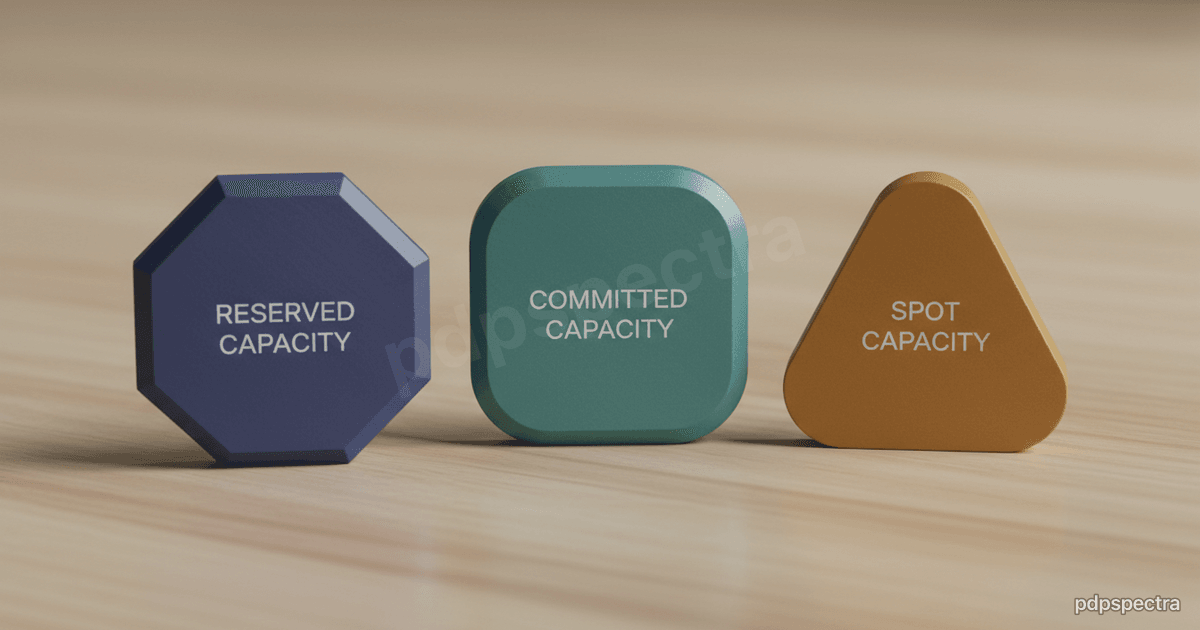
Reserved capacity is the highest-leverage FinOps move most enterprises do not execute well. The numbers are not subtle: a serious commitment strategy on AWS, GCP, or Azure pulls 25 to 55 percent off your steady-state compute and database spend. And yet most organizations sit at 30 to 50 percent coverage instead of the 70 to 80 percent the FinOps Foundation reference architectures point to. The gap is not a knowledge problem in 2026 — it is an operational discipline problem.
This is the senior FinOps practitioner version of how reserved commitments actually work across the three major clouds in 2026.
AWS Savings Plans versus Reserved Instances#
AWS has been moving customers from RIs to Savings Plans since 2019, and by 2026 the practical default is Savings Plans for almost everything new. The shapes:
- Compute Savings Plans apply to EC2, Fargate, and Lambda; flexible across region, instance family, OS, and tenancy; 1 or 3-year commit; up to 66 percent off on-demand at 3-year all-upfront. The default we recommend for most workloads.
- EC2 Instance Savings Plans lock to a region and family but cover any instance size, tenancy, and OS; up to 72 percent off; 1 or 3-year. Right when you have a stable family choice.
- SageMaker Savings Plans cover SageMaker compute; up to 64 percent off; same commit terms.
- Standard Reserved Instances still exist for RDS, ElastiCache, Redshift, OpenSearch, MemoryDB. EC2 standard RIs are largely deprecated in favor of Savings Plans for new commits.
- Convertible Reserved Instances still exist but are dominated by Compute Savings Plans for the same flexibility tradeoff.
The Compute Savings Plan is the right default because the regret cost is low. If your workload mix shifts from c7i to m7i to r7i over the year, the commitment still applies. The savings versus the EC2 family-locked Plan is small (3 to 6 percent for most shapes), and the flexibility is worth it.
GCP Committed Use Discounts#
GCP’s CUDs come in two flavors and a 2024-2025 expansion to flexible commitments:
- Resource-based CUDs: commit to a specific instance type in a region; up to 57 percent off; 1 or 3-year.
- Spend-based CUDs (Flex CUDs): commit to a dollar-per-hour spend across Compute Engine and a few related services in a region; up to 28 percent off; more flexible. Closer in shape to AWS Compute Savings Plans.
- CUDs for memorystore, Cloud SQL, BigQuery slots, and AI infrastructure also exist with their own terms.
For most workloads on GCP we default to a layered approach: resource-based CUDs covering the steady-state floor of well-known instance shapes, flex CUDs covering the next layer of less predictable but stable spend, on-demand absorbing the spikes.
Azure Reservations and Savings Plans#
Azure has run both Reservations (instance-specific, 1 or 3-year, up to 72 percent off) and Compute Savings Plans (hourly dollar commitment across compute services, 1 or 3-year, up to 65 percent off) since 2022. The Azure Savings Plan is closer in spirit to AWS Compute Savings Plans; Reservations are closer in spirit to EC2 Instance Savings Plans.
In 2026, the FinOps practice on Azure looks similar to AWS: Savings Plans as the default flexible layer, Reservations on top for stable specific shapes, and the Hybrid Benefit story for Windows and SQL Server workloads bringing on-prem licenses.
The 70 to 80 percent coverage target#
The FinOps Foundation reference architectures, and our own experience across client engagements, point to a steady-state 70 to 80 percent commitment coverage as the practical optimum. Above that and the commitment risk (paying for capacity you do not use) starts to bite; below that and you are leaving real money on the table.
The math behind the target: most production workloads have a stable base load plus variable peak. The base load should be 100 percent covered by commitments; the variable portion should be partially covered by flexible commitments (Compute Savings Plans, Flex CUDs) and partially absorbed on-demand. When you compose those layers, the overall steady-state coverage lands around 70 to 80 percent.
The numbers that make the target real:
- Effective rate on covered compute after 3-year all-upfront Compute Savings Plans: typically 35 to 50 percent off on-demand list, depending on instance family.
- Effective rate on uncovered compute (on-demand): full list price.
- Blended monthly compute cost at 75 percent coverage: roughly 0.25 * list + 0.75 * 0.55 * list = 0.66 * list, or 34 percent off list.
- Blended monthly compute cost at 40 percent coverage: roughly 0.60 * list + 0.40 * 0.55 * list = 0.82 * list, or 18 percent off list.
That 16-point difference is real money on a six- to eight-figure monthly compute bill.
Why most organizations sit below the target#
We see four recurring failure modes when we audit FinOps practices:
Failure 1: No designated owner. When commitments live in a “shared responsibility” between finance and platform engineering, neither side actually runs the program. The decision to renew a 3-year commit needs a single owner with a quarterly cadence.
Failure 2: Commitment fear. Engineering leadership remembers being burned by a 3-year commit on an instance family that got deprecated. The answer is Compute Savings Plans and Flex CUDs — flexible enough that the family-deprecation risk is largely gone — not avoiding commitments.
Failure 3: No FinOps tooling. Running the program off a quarterly CSV export from the cloud console does not scale. Vantage, CloudZero, Datadog Cloud Cost Management, Cloudability (Apptio), Finout, and the cloud-native tools (AWS Cost Explorer + Compute Optimizer + Trusted Advisor) all do the work of recommending commitments and tracking coverage automatically.
Failure 4: Forgetting to recommit. A 1-year Savings Plan that expires in June and is not renewed costs real money for the next month until somebody notices the bill spike. The recommitment calendar needs to be on the FinOps owner’s calendar with a 60-day warning.
The tooling layer#
The 2026 FinOps tooling landscape:
- Vantage. Strong multi-cloud visibility, good recommendations engine, particularly strong for mid-market teams. Their public AWS pricing data and the cost-anomaly detection are useful.
- CloudZero. Stronger on cost-per-unit-economics work (cost per customer, cost per feature). The right pick when the business question is unit economics, not just total cost.
- Datadog Cloud Cost Management. The right pick when you are already a Datadog shop and want cost alongside performance in one dashboard. Less specialized than Vantage but real workflow integration.
- Cloudability (Apptio). Enterprise-incumbent option, strong for large-org governance and chargeback. Heavier to operate than the newer entrants.
- Finout. Strong on data-warehouse cost (Snowflake, BigQuery, Databricks) alongside cloud. Right pick if data-platform spend is your biggest variable.
- Cloud-native (AWS Cost Explorer + Compute Optimizer + Trusted Advisor, GCP Recommender, Azure Advisor + Cost Management). Free, decent, integrated. The right starting point before adding a third-party tool.
We typically recommend starting with cloud-native tooling, layering Vantage or CloudZero when the cost surface justifies the spend (usually around 200k to 500k monthly cloud bill or higher), and adding Finout if data-platform spend is a major line.
The operational cadence#
The practice that actually works at clients we have run FinOps engagements with:
- Weekly: review the previous week’s spend, flag anomalies, route to teams.
- Monthly: review commitment coverage, identify expiring commitments, recommend renewals.
- Quarterly: revisit the commitment portfolio, evaluate term length (1 vs 3-year) given workload stability, model the next quarter’s planned changes.
- Annually: strategic FinOps review with engineering and finance — coverage targets, tooling, chargeback model, savings achieved.
The cadence is what makes the target. Coverage drifts without it.

Where reserved commitments do not help#
Three workload shapes where reserved capacity does not improve economics meaningfully:
- Spiky batch with extreme amplitude. A nightly 20-node Spark job that runs for an hour and then nothing is better handled with spot or preemptible capacity than reserved.
- Very short-lived workloads. Lambda and Cloud Functions have their own pricing models; the Compute Savings Plan applies to Lambda but the discount is modest.
- GPU training spend. Reserved GPU capacity exists but the better play is usually a mix of neocloud reservations and spot — see our GPU rental piece and our spot instance strategies take.
Where pdpspectra fits#
Our cloud infrastructure and DevOps and CI/CD practices include FinOps engagements — coverage modeling, tooling selection, recommitment cadence, and the chargeback architecture that makes engineering teams care about cost. We have done this for hospital, banking, and SaaS clients running into the multi-million-dollar annual cloud spend range.
Related reading: FinOps cloud cost optimization, spot instance strategies, and cloud egress cost optimization.
Reserved capacity is the highest-leverage FinOps move most teams do not execute. Talk to our team about your commitment strategy.