Agricultural Robots in 2026: John Deere, Naio, Carbon Robotics, Burro
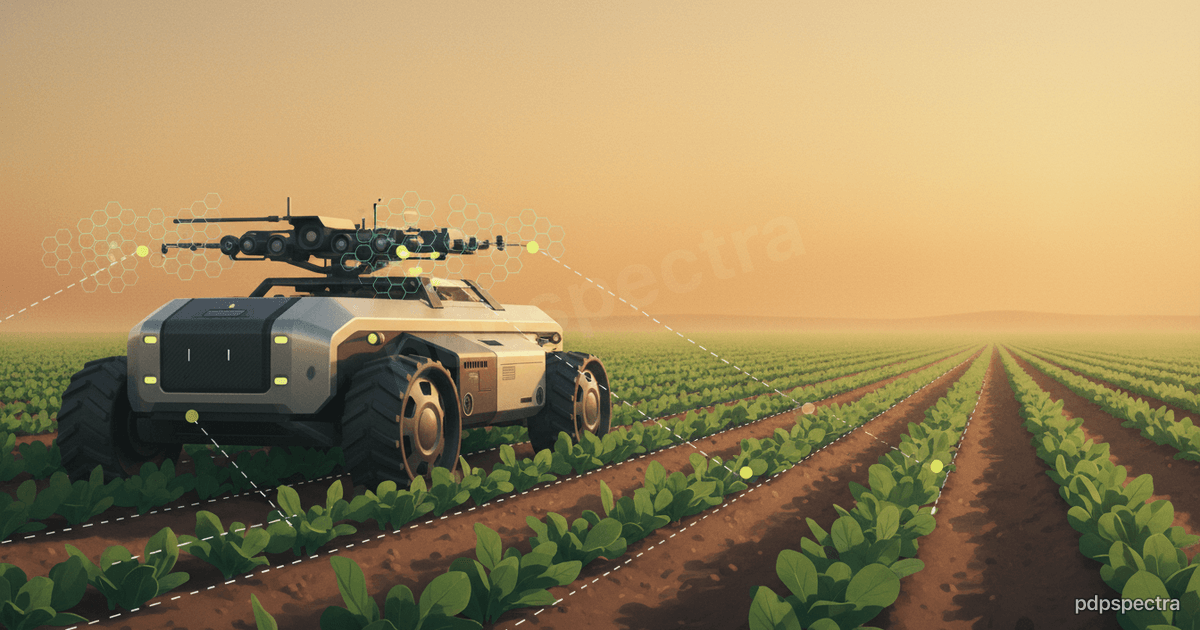
John Deere See & Spray, Naio Technologies, FarmWise, Carbon Robotics LaserWeeder, Burro autonomous farm cart, Iron Ox, Bowery — agricultural robotics in 2026 is driven by labor shortages and a real ROI.

Agricultural robotics in 2026 has stopped being a research story and started being an economic one. Labour shortages across US farming, Northern European horticulture, and Australian/NZ orchards have made automation a survival issue, not a productivity nicety. The combination of cheaper sensors, capable foundation models, and the cumulative effect of a decade of GPS-guided autosteer has produced a real market.
John Deere is the platform incumbent. Naio Technologies, FarmWise, Carbon Robotics, and Burro are the focused specialists. Iron Ox and Bowery represent the indoor-farming experiment. Here’s the 2026 read on each, and where the technology actually moves the economics.
John Deere: from autosteer to autonomous#
John Deere is no longer a tractor company; it’s an autonomous agricultural platform that happens to sell tractors. The 2022 announcement of the fully autonomous 8R tractor, the 2024 expansion to the 9RX 830 autonomous tractor for large-scale tillage, and the steady rollout of See & Spray have repositioned Deere as the platform layer for North American farming.
See & Spray Ultimate, Deere’s targeted-herbicide system, uses cameras and machine learning to identify weeds in row crops and spray only the weeds — not the entire field. The herbicide reduction is meaningful (Deere reports up to 60% less herbicide on validated farms), and the economics flip the system from “expensive add-on” to “self-paying within 2-3 seasons” at modern herbicide prices.
The data flywheel is the underlying moat. Every Deere machine in the field is sending operational and vision data back through John Deere Operations Center. Deere has the largest agricultural training dataset in the world. New customers buying into the Deere ecosystem are buying into that dataset’s benefits.
Competing combine and tractor makers (CNH/Case IH, AGCO, Kubota) are racing to close the gap. They’re not closed yet.
Naio Technologies: the European row-crop specialist#
Naio Technologies, based in Toulouse, France, builds compact autonomous robots for row-crop weeding and tending. Their Oz, Dino, and Ted platforms are sized for European farm geometry — smaller, more nimble, designed for vegetable and vineyard work where John Deere’s scale doesn’t fit.
Naio has deployed across France, the Netherlands, Germany, Spain, and increasingly the US. The pitch is electric, autonomous, and chemically light — weeding is mechanical (blade or finger weeder), not herbicide-based, which fits the European organic and reduced-chemical trajectory.
Naio is profitable on a per-unit basis but the addressable market is still niche. The 2026 question is whether smaller farms across Southern Europe and the US specialty-crop segment buy in volume.
FarmWise: weeding-as-a-service#
FarmWise, San Francisco-based, makes a row-crop mechanical weeder. After early difficulty with the capital-intensive sell-the-robot model, the company pivoted toward a service model — FarmWise sends crews with robots to farms during weeding windows. That model produced better unit economics and a clearer growth path.
The 2026 read on FarmWise is that the service model works for specialty crops (leafy greens, broccoli, lettuce) in California’s Central Valley. Whether it scales to commodity row crops is unclear; the economics there favor John Deere’s See & Spray approach.
Carbon Robotics LaserWeeder: the visible disruptor#
Carbon Robotics, Seattle-based, makes the LaserWeeder — a pull-behind implement that uses computer vision and high-powered lasers to kill weeds. No herbicide, no mechanical contact with the soil. The 2024-2025 deployments at major California vegetable growers (Bonipak, Pacific Tomato Growers, others) produced real adopter case studies.
The LaserWeeder is expensive (north of $1M list price) but for organic operations where herbicide isn’t an option, the math works at scale. Carbon raised at significant valuations through 2023-2024 and is one of the most visible US agtech robotics companies.
The honest assessment: laser weeding is dramatic and effective in the right crops, but it’s not going to replace See & Spray for commodity row crops. Different segments, different economics.
Burro: autonomous farm cart#
Burro, Philadelphia-based, makes a small autonomous cart that follows workers in orchard and vineyard settings, carrying picked fruit. It’s not glamorous; it solves a specific labor problem (pickers spend a meaningful fraction of their time walking to the truck and back) and the unit economics work.
Burro has deployed thousands of units across US berry and grape operations. The product is intentionally narrow — follow, carry, return — and the ROI calculation is straightforward. It’s a model for what agricultural robotics looks like when the company picks a focused job and executes well.
Burro extended into autonomous spraying and other tasks in 2024-2025 by leveraging the same platform. The platform-after-traction pattern is healthy.
Indoor farming and Bowery, Iron Ox#
The indoor vertical-farming sector that boomed in 2020-2022 has cooled meaningfully. Bowery Farming closed key facilities in 2023-2024 and went through restructuring. AeroFarms filed for bankruptcy. Plenty raised additional capital but contracted operations.
Iron Ox, the indoor-greenhouse robotics company, restructured in 2023. The robotics work was technically interesting (custom robots moving plant modules around a controlled environment) but the unit economics never closed against open-field production.
The 2026 read on indoor farming is sober: the energy economics are punishing for staple crops, and only specialty leafy greens and herbs justify the capex. Robotics inside indoor facilities is real but the addressable market is smaller than 2021 hype suggested.
The bigger indoor-AI play in 2026 is greenhouse-attached robotics — Dutch and Israeli companies (Priva, Hortilux, FFRobotics for apple picking) integrating with traditional greenhouse operations rather than building from scratch.
Labour shortage as the actual driver#
The 2026 boom in agricultural robotics is fundamentally a labour story. US H-2A visa processing slowed, agricultural wages rose meaningfully, and the demographic trend of fewer young people entering farm work continued. European seasonal-labour flows tightened post-Brexit and through changing migration patterns. Australia and New Zealand orchard operations regularly run short on pickers during peak season.
Against that backdrop, a robot that costs $300,000 and replaces three seasonal workers at $50,000 each (loaded cost) pays back inside two seasons. That math is what’s actually closing sales — not the technology demos.

What’s not working yet#
Honestly, the unsolved problems in 2026 agricultural robotics:
- Selective fruit picking at scale — apple, citrus, soft fruit picking robots exist (Tevel, FFRobotics, Advanced Farm) but throughput and damage rates aren’t yet at human-equivalent for most crops
- Livestock robotics — milking robots (Lely, DeLaval, GEA) are mature, but other livestock work is still mostly manual
- General-purpose field robots — the foundation-model bet that you’d have one platform for many crops hasn’t materialised; most successful products are crop-specific
- Long-distance autonomy on public roads — moving equipment between fields autonomously isn’t legal or practical yet in most jurisdictions
These will close over the next 3-5 years but they’re not closed in 2026.
What we tell agricultural clients#
For agricultural operations sizing automation in 2026, the practical posture:
- Start with the data layer — even if you can’t deploy robots yet, the operational data (planting, application, harvest, weather, soil) is the substrate for any automation
- John Deere ecosystem for commodity row crops — Deere’s Operations Center plus See & Spray is the realistic large-farm starting point
- Specialised vendors for specialty crops — Naio, FarmWise, Carbon Robotics each fit specific contexts
- Burro pattern for orchards and vineyards — narrow, focused, ROI-clear
Our business automation work often shows up here on the data and integration side — the ERP, the field-data, the supply-chain, the regulatory reporting. The robots are the visible part; the data spine is what makes them part of an operating business.
Related reading#
- AI in agriculture: precision farming patterns
- Industrial robotics in 2026: FANUC, ABB, KUKA
- Humanoid robots: Figure, Tesla, Apptronik
Agricultural robotics in 2026 is real, labour-driven, and finally producing clear ROI for the right crops. If you’re sizing a farm or agricultural-supply-chain automation roadmap, our business automation team builds the data and integration spine. Tell us about the operation.