AI Grid Management in 2026: AutoGrid, Bidgely, Uplight and the DER Orchestration Era
AutoGrid (Schneider), Bidgely, Uplight, virtual power plants, demand response — the 2026 grid management map and the ISO/RTO interfaces that matter.

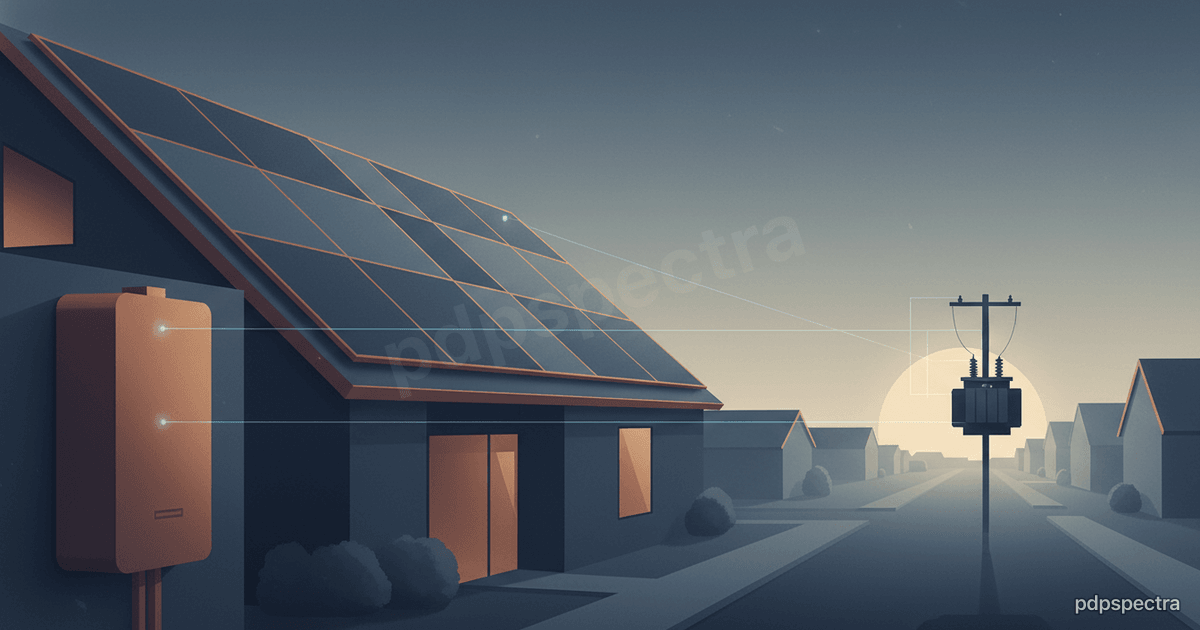
The defining shift in grid management between 2022 and 2026 has been the move from one-way utility-to-customer flow to a genuinely two-way grid where rooftop solar, behind-the-meter batteries, EV chargers and flexible loads have to be orchestrated as managed grid assets. That shift has reshuffled the vendor map, pulled AutoGrid into Schneider Electric, made virtual power plants a real operating category rather than a pilot, and forced ISOs and RTOs to rewrite tariffs faster than their five-year cycles used to allow. This post walks through where the stack sits.
The vendor map after the AutoGrid acquisition#
Schneider Electric’s acquisition of AutoGrid in 2022, completed and operationally integrated by 2024, was the single most consequential consolidation in the DER-orchestration space. AutoGrid Flex, the platform that aggregates and dispatches distributed energy resources, is now bundled into Schneider’s EcoStruxure Grid offering and sells alongside ADMS and DERMS deployments at major utilities. The combined offering competes most directly with Generac Grid Services (the descendant of Enbala), Itron Grid Edge Intelligence, and the DERMS modules from GE Vernova, Siemens and Oracle.
Bidgely sits a layer up — AMI-data analytics that disaggregates household consumption into appliance-level signatures, then feeds personalised engagement, demand-response targeting and load-forecasting models. Its appliance disaggregation has been deployed at PG&E, NRG, Duke and dozens of European utilities. Uplight, formed from the merger of Tendril, Simple Energy and several others, has become the customer-facing engagement and demand-response platform for a large share of US IOUs, with its acquisition of AutoGrid-adjacent assets and its 2024-2025 push deeper into VPP enrolment workflows. Tibco Spotfire remains a common analytics layer for DER and grid-operations dashboards at utilities that have standardised on it for other operational reporting.
What virtual power plants actually look like in 2026#
The phrase “virtual power plant” has been used loosely for a decade. By 2026, in mature markets, it means something specific: an aggregator with a market-participation agreement with the ISO or RTO, a software platform that can forecast, dispatch and settle distributed resources at five-minute or sub-five-minute granularity, and a pool of enrolled assets large enough to bid into wholesale energy, ancillary services and capacity markets. Tesla’s California VPP, now several hundred megawatts of aggregated Powerwalls, participates in CAISO’s emergency load reduction program. Sunrun, Sonnen and Swell Energy run similar aggregations across multiple territories. AutoGrid’s platform underpins many utility-led VPPs where the utility itself is the aggregator.
CAISO’s DSGS and ELRP programs, ERCOT’s emergency response service, PJM’s capacity performance program, NYISO’s DER participation model and the FERC Order 2222 implementations across the remaining RTOs have all converged on the same basic architecture by 2026 — distributed resources can participate in wholesale markets either directly above a minimum size or through an aggregator below it. The software work is the bookkeeping, telemetry, baseline calculation, settlement and audit trail that lets a megawatt of dispatched Powerwalls clear as a real market product.
Demand response, the mature side of the same coin#
Classical demand response — paying or contracting commercial and industrial customers to reduce load during scarcity events — remains larger in megawatt terms than VPPs in most regions and is the use case where AI has the longest track record. Forecast event triggers, baseline calculation, customer targeting, automated DR dispatch and settlement are all areas where ML has produced demonstrable improvements over rule-based programs. CPower, Enel X, Voltus and the in-house programs at large IOUs have all moved to ML-driven baseline and targeting in 2024-2026.
ISO/RTO interfaces and the data engineering work#
The unglamorous core of grid AI in 2026 is interface engineering. CAISO publishes locational marginal prices, ancillary service prices and SCED outputs on five-minute and hourly cadences via OASIS APIs and the newer ALFS feeds. ERCOT publishes equivalent data through MIS Public Reports. PJM, MISO, ISO-NE, NYISO and SPP each have their own conventions, data formats and rate limits. Any production VPP or DR platform has to ingest these feeds reliably, normalise them into a comparable schema, handle the periodic format changes the ISOs push out, and feed real-time dispatch loops without dropping data during the high-stress events that determine settlement.
Most production teams have settled on Kafka for the streaming layer, Snowflake or Databricks for the analytics warehouse, and a small set of specialised time-series stores — InfluxDB, Timescale, ClickHouse — for the sub-second telemetry and forecast curves. The forecasting models themselves are increasingly transformer-based for the longer horizons and gradient-boosted trees for the short ones.

The regulatory cage#
Grid AI lives inside a regulatory environment that does not look like any other industry. NERC CIP standards govern cybersecurity for bulk electric system assets, which constrains how cloud platforms can connect into operational systems. State PUCs review cost recovery and prudency. FERC orders and ISO tariff filings dictate how aggregators can participate in markets. Customer AMI data is increasingly regulated under state privacy laws. The teams that have built production grid AI work with regulatory counsel as much as with data engineers — model documentation, change-management evidence and explainability artefacts are deliverables on the same timeline as the models themselves.
Where the projects still fail#
The recurring failure mode in DER orchestration is treating it as a software-only project and underinvesting in field telemetry. A VPP whose battery telemetry lags by five minutes cannot bid into a real-time ancillary services product no matter how clever the optimiser is. The other recurring failure is regulatory misalignment — running a pilot under one tariff structure and discovering that the production tariff requires a fundamentally different settlement architecture.
Where pdpspectra fits#
Our data engineering practice helps utilities and aggregators build the ISO-feed ingestion, DER-telemetry and settlement-grade audit trail that production grid AI requires. We work alongside AutoGrid, Uplight and Bidgely deployments and build custom orchestration layers for utility-led VPPs.
Related reading: AI in energy and utilities in 2026, energy grid optimization with ML on smart-meter data, and energy demand forecasting on grids.
Grid AI in 2026 is a production operations discipline with a regulatory perimeter. Talk to our team about your DER or VPP platform.