AI Impact on Belgium: Jobs and Industries in 2026
Belgium's AI economy in 2026 is shaped by EU-institution proximity, a deep chemicals and pharma base, KBC's banking AI lead, and Flemish manufacturing strength.

Belgium in 2026 is a small, federally complex, deeply European economy whose AI position is shaped by three structural facts: Brussels is the gravitational center of EU regulation including the AI Act, Flanders has a dense chemicals-pharma-engineering cluster, and Belgian banks reach a level of AI maturity that punches above the country’s 11.7-million-person size. The federal structure — Flemish, Walloon, and Brussels-Capital regions with their own innovation agencies — means AI policy is rarely a single document, and the EU-institution presence means that Brussels-based AI work is often coupled to lobbying, standards-setting, and compliance-product motions that do not exist in other capitals.
This post walks through Belgium’s AI impact sector by sector, then the workforce, geography, and policy picture.
Sector-by-sector impact#
EU institutions and the regulatory cluster#
Brussels concentrates the European Commission, the Council, the European Parliament’s working seat, NATO, plus the dense ecosystem of think tanks, law firms, and consultancies that orbit them. That cluster is itself a significant AI customer — Commission services have rolled out internal AI assistants, translation augmentation, document AI for the acquis, and case-management tooling. The AI Act has created a Brussels-headquartered compliance-tech micro-industry, with firms building risk-classification, model-card, and conformity-assessment products aimed at large EU operators.
Banking and financial services#
Belgian banking is concentrated around KBC, BNP Paribas Fortis, Belfius, and ING Belgium. KBC has been one of Europe’s most consistent AI adopters for years — its Kate digital assistant has been in production across the Flemish and broader customer base since the late 2010s and now sits at the center of an AI-first retail-banking strategy. AML, fraud, and underwriting AI are mature across the four anchors. Insurance — AG Insurance, Ageas, AXA Belgium, Allianz Benelux — runs claims-triage and pricing models in production. The Brussels-based payments and clearing infrastructure adds another AI demand axis.

Chemicals, materials, and pharma#
The chemicals-and-pharma backbone is the most under-discussed Belgian AI story. Solvay, BASF Antwerp, Covestro, Borealis, and the Antwerp port-chemical cluster are running process AI, predictive maintenance, energy optimization, and increasingly molecular-discovery work. UCB, Janssen Pharmaceutica which is the Belgian arm of Johnson and Johnson Innovative Medicine, and GSK Belgium are AI-heavy in drug discovery, clinical operations, and manufacturing. The biotech cluster around Ghent — Argenx, Galapagos, ViaCyte partners, plus the VIB research institute — is one of Europe’s strongest and has folded AI into discovery pipelines.
Advanced manufacturing and 3D printing#
Materialise, headquartered in Leuven, is the global anchor of medical and industrial 3D printing software and runs AI throughout its design, simulation, and quality stack. Around Materialise sits a wider Flemish advanced-manufacturing cluster — Picanol in weaving machinery, Bekaert in steel-wire transformation, Atlas Copco’s Belgian operations, plus the Audi Brussels and Volvo Cars Ghent plants. AI for vision inspection, predictive maintenance, and energy is in production rather than pilot.
B2B SaaS and product#
The Belgian product layer is real if smaller than the Dutch one. Showpad in sales enablement, Odoo in open-source ERP from Wallonia, Collibra in data governance with strong US presence but Belgian origins, Teamleader, Silverfin, Lighthouse, and Tessian-style security plays make up the visible names. AI features are now table stakes across this set.
Logistics and the Antwerp port#
The Port of Antwerp-Bruges is one of Europe’s largest and a steady AI buyer in vessel scheduling, container routing, customs documentation, and emissions reporting. Around it sits a logistics-services cluster — DHL, Katoen Natie, Sea-Invest — that is similarly AI-aware.
Public sector#
Federal and regional digitization is uneven but progressing. The federal eHealth platform, the eBox citizen-document service, the regional employment agencies VDAB and Forem, and the tax administration FOD Financien have all rolled out AI assistants and document AI. Flanders is generally ahead of Wallonia on AI deployment, partly through Imec and the Flemish AI plan.
Job categories growing and shrinking#
| Role | Direction | Driver |
|---|---|---|
| AI and ML engineers | Strongly growing | Bank, pharma, chemicals |
| Data and platform engineers | Strongly growing | KBC and industrial modernization |
| Compliance and AI-governance specialists | Strongly growing | EU AI Act pull |
| Cloud and DevOps engineers | Growing | Brussels and Antwerp regions |
| BPO and shared-service agents | Declining | Copilot and deflection |
| Mid-level translators | Declining | Generative tooling |
| Junior QA | Declining | Test automation |
| Chemical-plant technicians | Stable, upskilling | Process AI |
| Cybersecurity analysts | Strongly growing | Threat environment |
Geographic distribution within the country#
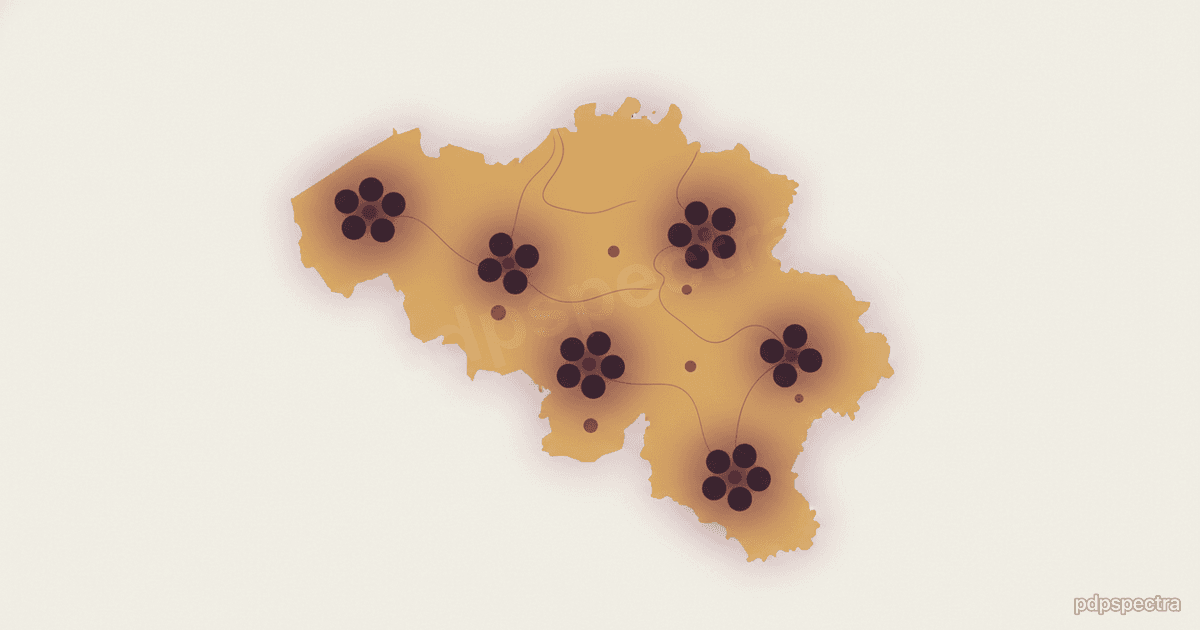
Brussels concentrates the institutional, banking, and consulting AI demand. Antwerp anchors the chemical cluster, the port, and a real product-tech scene. Ghent is the biotech and university anchor. Leuven, through Imec and KU Leuven, is arguably the densest research-to-industry AI node in the country. Liege, Charleroi, and Namur in Wallonia have a smaller but growing presence, with Liege’s logistics around the airport and Charleroi’s biotech cluster around the BioPark. Wallonia overall lags Flanders on AI density but is catching up through targeted regional programs.
Policy and regulatory framework#
Belgium’s AI rules sit inside the EU framework. The EU AI Act, GDPR, the Data Act, and the Digital Services Act are the primary instruments, with Brussels itself as the political center of those rules. Domestic enforcement is split between the federal Data Protection Authority and sectoral regulators. Regional AI policy runs through VAIA in Flanders, AI4Wallonia, and the Brussels Innoviris programs. Imec in Leuven is the country’s most consequential public research institute on AI hardware and systems.
What’s distinctive about Belgium’s AI trajectory#
Three features set Belgium apart. First, the EU-institution proximity gives Belgian AI operators an unusual front-row seat on regulation, which has produced both a real compliance-tech cluster and a sharper-than-average policy literacy across enterprise AI buyers. Second, the chemicals-pharma backbone provides a genuinely demanding industrial AI use case that pulls vendors and talent toward process and discovery work rather than only consumer surface features. Third, the federal-regional structure means AI rollouts are negotiated rather than imposed, which slows adoption in some pockets and accelerates it in others.
Where pdpspectra fits#
Our Belgium-relevant work centers on industrial AI and LLM integration for chemicals and pharma operators, data engineering for bank modernization, and business automation for EU-institution-adjacent compliance workflows.
Related reading: AI impact in the Netherlands, AI impact in Germany, and AI impact in France for a peer-market view.
Belgium is a small but compounding European AI market in 2026. Talk to our team about your Belgian AI deployment plan.