AI Impact on Croatia: Jobs and Industries in 2026
Croatia's AI economy in 2026 is shaped by Rimac's EV engineering, Infobip's CPaaS scale, post-euro-accession growth, and tourism digitization.

Croatia in 2026 is a small EU economy of roughly 3.9 million people, three years into euro and Schengen membership, and finally beginning to translate decades of strong engineering education into globally recognized AI-relevant output. The headline names — Rimac Automobili and Infobip — are the most-visible part of a wider story that includes a real outsourcing and product layer, a tourism economy that is being aggressively digitized, and a manufacturing belt that is upgrading partly under EU recovery funds and partly under wage and demographic pressure.
This post walks through Croatia’s AI impact sector by sector, then the workforce, geography, and policy picture.
Sector-by-sector impact#
Electric vehicles and high-performance mobility#
Rimac Automobili, headquartered in the new Rimac Campus near Zagreb, is the country’s most-consequential industrial-AI anchor. The hypercar program — Nevera and successors — and the Bugatti Rimac joint venture get the press, but the bigger story is the Rimac Technology arm that supplies battery systems, powertrains, and increasingly autonomous-driving subsystems to other OEMs. AI is in battery-management software, ADAS perception, and the manufacturing line. Project 3 Mobility, the autonomous-robotaxi venture spun out of the same group, has moved from pilots to limited service in Zagreb.
Communications platforms and B2B SaaS#
Infobip, headquartered in Vodnjan in Istria, is one of the largest CPaaS operators globally and the largest Croatian software company by revenue and headcount. AI sits across the platform — conversational support, intent classification, agentic flows for enterprise customer service, plus the Moments customer-engagement stack. Around Infobip is a wider Croatian product layer — Photomath now part of Google, Mindsmiths, Productive, Q agent, Notch, plus a long tail of indie SaaS — that has made AI features default rather than optional.

IT services and capability hubs#
The outsourcing and capability-hub layer is real if smaller than Poland’s or Romania’s. Cisco’s Zagreb development center, Ericsson Nikola Tesla, Atos, IBM Croatia, plus the European operations of Endava, NTT Data, and a wave of mid-sized local services firms — Span, Combis, King ICT, Asseco SEE — make IT services a meaningful AI buyer. The Zagreb-Split-Rijeka triangle has matured into a credible nearshore base for German, Austrian, Swiss, and Nordic buyers.
Tourism, hospitality, and the Adriatic coast#
Tourism accounts for an outsized share of Croatian GDP, and tourism digitization is one of the country’s most visible AI deployments. Valamar, Plava Laguna, Maistra, and the broader hotel and rental sector are running revenue-management AI, dynamic pricing, demand forecasting, and increasingly multilingual conversational concierge. The platform layer — Booking.com’s Croatian operations, plus local players like Direct Booker — has substantial recommendation and pricing AI in production. Around the coast, port operators, marina chains, and ferry operator Jadrolinija are upgrading scheduling and capacity AI.
Manufacturing and industrial#
Croatian manufacturing is concentrated and steadily modernizing. Konar, Ericsson Nikola Tesla on the industrial side, Podravka in food, Atlantic Grupa in consumer goods, AD Plastik in automotive supply, plus the Brodogradiliste shipyards have all absorbed vision-based quality and predictive-maintenance AI. The defense layer — HS Produkt as the most-visible firearms exporter, plus emerging drone and electronics suppliers — has grown sharply since 2022.
Banking and financial services#
Croatian banking is concentrated and largely foreign-owned — Zagrebacka Banka under UniCredit, PBZ under Intesa Sanpaolo, Erste, Raiffeisen, OTP, plus the state-owned HPB. AI in fraud, AML, conversational support in Croatian, and underwriting is in production. The post-euro-accession adjustment has been smoother than expected and freed bank engineering capacity for AI rather than currency-conversion work.
Public sector#
Government digitization runs through the e-Gradani citizen portal, the e-Poslovanje business portal, the tax administration ePorezna, and the health-system platforms. The Ministry of Digital Affairs has moved AI from policy paper into pilot deployments, and EU recovery funds have accelerated the rollout.
Job categories growing and shrinking#
| Role | Direction | Driver |
|---|---|---|
| AI and ML engineers | Strongly growing | Rimac, Infobip, services |
| Data and platform engineers | Strongly growing | Bank and retail modernization |
| EV and battery engineers | Strongly growing | Rimac and supply base |
| Tourism revenue managers | Growing | Coastal digitization |
| BPO and shared-service agents | Declining | Copilot and deflection |
| Mid-level translators | Declining | Generative tooling |
| Junior QA | Declining | Test automation |
| Shipbuilding technicians | Stable, upskilling | Vision and process AI |
| Cybersecurity analysts | Strongly growing | EU and NATO pull |
Geographic distribution within the country#
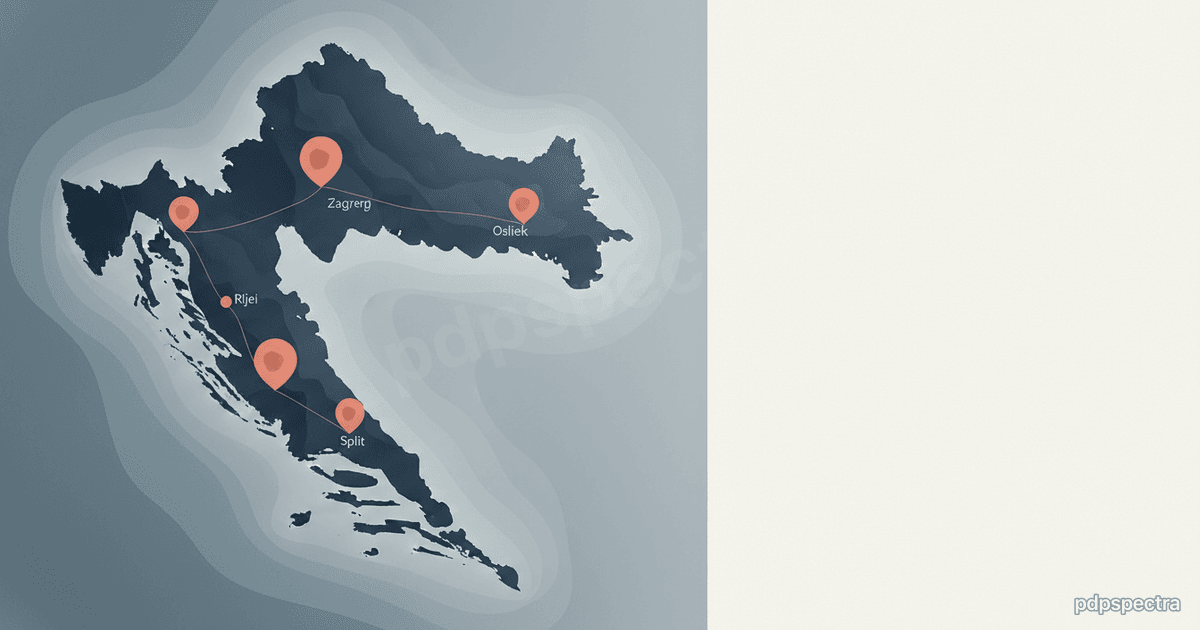
Zagreb concentrates the largest share of Croatian AI activity — banking HQs, government, Rimac Campus on the outskirts, plus most of the venture-backed product companies. Split is the strong second anchor, with a growing IT services and product scene, tourism digitization, and the University of Split. Rijeka and the broader Kvarner region anchor logistics, shipbuilding, and a real tech presence around the University of Rijeka. Osijek in Slavonia hosts a growing software cluster and the agritech connection to the Pannonian plain. Pula and the broader Istria region host Infobip and a steady flow of remote-friendly product firms. The Dalmatian hinterland and the southern coast lag on AI density.
Policy and regulatory framework#
Croatia’s AI rules sit inside the EU framework. The EU AI Act, GDPR, the Data Act, and the Digital Services Act are the primary instruments, enforced locally by AZOP for data protection. National AI policy runs through the Ministry of Digital Affairs and the National AI strategy. EU structural and recovery funds are the dominant public funding channel. Euro and Schengen accession have removed practical frictions that previously slowed cross-border AI deployment.
What’s distinctive about Croatia’s AI trajectory#
Three features set Croatia apart from peer CEE markets. First, the Rimac story has shown that a country of fewer than 4 million can produce a globally relevant deep-tech platform, and that example has reset what local engineers and founders consider plausible. Second, the tourism share of GDP creates an unusually concentrated AI use case in revenue management and seasonality forecasting, which is unlike any other EU country. Third, the post-2023 euro and Schengen membership has reduced the friction of cross-border AI operations to near-Western-EU levels while wages remain meaningfully below those countries, which is keeping the nearshore model attractive.
Where pdpspectra fits#
Our Croatia-relevant work centers on industrial AI and LLM integration for mobility and manufacturing operators, data engineering for bank and tourism platforms, and DevOps and CI/CD for distributed product organizations.
Related reading: AI impact in Poland, AI impact in Italy, and AI impact in Germany for a peer-market view.
Croatia is a small, focused, increasingly visible European AI market in 2026. Talk to our team about your Croatian AI deployment plan.