AI Impact on Finland: Jobs and Industries in 2026
Finland's AI economy in 2026 is shaped by Nokia heritage, a deep mobile-gaming cluster, Aalto research, defense investment, and an education-export model.

Finland in 2026 is a small, deeply technical economy that punches well above its 5.6-million-person weight in AI. The structural ingredients are familiar to anyone who has worked the Nordic market: a high-trust public sector, near-universal English fluency, world-class engineering education through Aalto and the Helsinki and Tampere universities, a Nokia-trained generation of senior engineers who fanned out into product and platform companies, and an industrial base — Kone, Wartsila, Metso, Stora Enso, UPM — that treats software and AI as cost-of-doing-business rather than a marketing line. NATO accession in 2023 and the ongoing defense buildup have added a new layer on top of that.
This post walks through Finland’s AI impact sector by sector, then the workforce, geography, and policy picture.
Sector-by-sector impact#
Telecom, networks, and the Nokia legacy#
Nokia, headquartered in Espoo, remains the single largest private employer in Finnish tech and the country’s most consequential AI buyer. The 5G and emerging 6G work, the network-management AI portfolio, the optical and IP businesses, and Nokia Bell Labs all run AI-heavy workloads. Around Nokia sits a long tail of network-software vendors and capability hubs — Ericsson’s Finnish operations, Cisco, plus telco buyers Elisa, Telia Finland, and DNA — that have absorbed Nokia alumni and continue to drive AI demand in network optimization, fault prediction, and customer operations.
Mobile gaming and entertainment#
Helsinki is one of the densest mobile-gaming clusters in the world. Supercell, Rovio (now part of Sega), Small Giant Games, Metacore, Fingersoft, Next Games, and a wave of newer studios have made gaming a genuine pillar of Finnish AI demand. AI is in the live-ops loop — matchmaking, churn prediction, content personalization, fraud, player support automation — and increasingly in the creative pipeline, where generative tooling helps art and narrative teams iterate. Supercell’s data-engineering posture is widely studied as a reference for high-revenue-per-employee live-services operations.

Food delivery, marketplaces, and consumer tech#
Wolt, founded in Helsinki and now operating across Europe under DoorDash ownership since 2022, is the single most visible Finnish consumer-tech story of the last decade. The platform has invested heavily in routing, demand forecasting, restaurant pricing, and courier dispatch AI. Around Wolt sit smaller marketplace and SaaS firms — Smartly.io in social ad automation, Relex Solutions in retail forecasting, M-Files in document management — that have made AI a default rather than a feature.
Industrial, machinery, and forest products#
Finland’s industrial base is where AI adoption is quietly deep. Kone runs predictive maintenance AI across its global elevator and escalator fleet from a Helsinki-region command structure. Wartsila does the same for marine and power-plant assets. Metso, Outotec, Konecranes, and Valmet are running vision and process-control AI in mining, port, and paper-mill installations. Stora Enso and UPM, the two pulp-and-paper giants, are using AI in forest inventory, mill optimization, and the slow transition into bio-based packaging and chemicals.
Defense and dual-use#
Defense AI is a new growth axis. Patria, the state-controlled defense industrial group, has expanded sharply since 2022 and pulled AI into vehicle electronics, sensor fusion, and training systems. NATO accession has opened export channels and brought Finnish defense suppliers into broader European programs. A small but credible defense-tech startup scene — drone, situational-awareness, and counter-UAS plays — has emerged around Helsinki and Tampere.
Education and edtech#
Finnish education export is a distinctive Finnish AI story. The Finnish school model, the teacher-training apparatus, and the open-online-course infrastructure built around the University of Helsinki’s Elements of AI program have become products in their own right, sold to governments and enterprises worldwide. Edtech firms — Funzi, Eduten, Claned, Sanoma Learning — are layering AI tutoring, assessment, and language tooling onto that base.
Financial services#
Finnish banking is concentrated — OP Group, Nordea, Danske Bank Finland, and Aktia — and has deployed AI for fraud, AML, conversational support in Finnish and Swedish, and underwriting. The fintech layer is smaller than Sweden’s but real: Holvi, Enfuce, and a wave of embedded-finance plays. Insurance — If, Pohjola, LahiTapiola — has model deployments for claims triage and pricing.
Job categories growing and shrinking#
| Role | Direction | Driver |
|---|---|---|
| AI and ML engineers | Strongly growing | Nokia, gaming, industrial |
| Data and platform engineers | Strongly growing | Industrial and retail modernization |
| Defense engineers | Strongly growing | Post-NATO accession spend |
| Game live-ops analysts | Growing | Studio expansion |
| Cybersecurity analysts | Strongly growing | Threat environment |
| BPO and shared-service agents | Declining | Copilot and deflection |
| Mid-level translators | Declining | Generative tooling |
| Junior QA | Declining | Test automation |
| Forest-mill operators | Stable, upskilling | Vision and process AI |
Geographic distribution within the country#
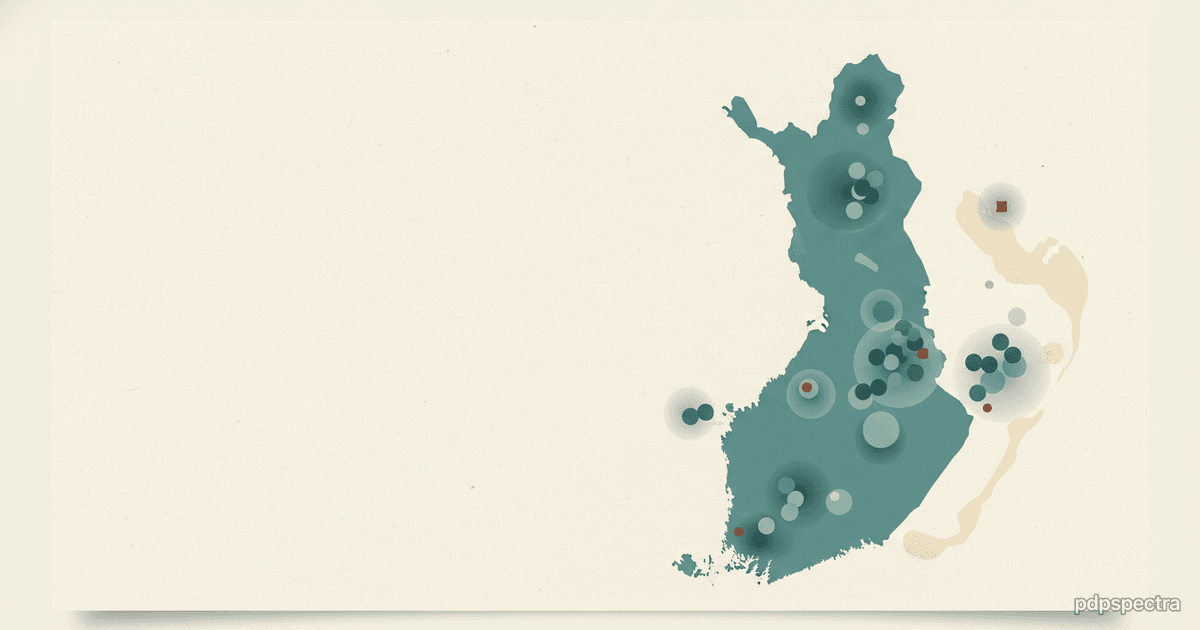
Helsinki and the surrounding Uusimaa region — including Espoo where Nokia is headquartered and Vantaa where the airport sits — concentrate the great majority of Finnish AI activity. Tampere is the strong second anchor, with Nokia engineering, Tampere University, and a growing defense and machine-vision cluster. Oulu is the historic 5G and telecom-research hub and still home to deep wireless engineering. Turku rounds out the picture with maritime, biotech, and the Aboa Mare ecosystem. The eastern and northern regions lag on AI density, though Lappeenranta and Rovaniemi have niche strengths.
Policy and regulatory framework#
Finland’s AI rules sit inside the EU framework. The EU AI Act, GDPR, the Data Act, and the Digital Services Act are the primary instruments, enforced locally by the Data Protection Ombudsman and the Finnish Transport and Communications Agency Traficom for sectoral cases. National AI policy runs through the AI 4.0 program and the Ministry of Economic Affairs and Employment. Business Finland is the main public funding channel. The Finnish Center for Artificial Intelligence FCAI, jointly run by Aalto and the University of Helsinki, anchors research.
What’s distinctive about Finland’s AI trajectory#
Three features set Finland apart. First, the Nokia-trained engineering diaspora has seeded a uniquely deep pool of senior platform and ML talent for a country of this size, and that talent is now compounding through the gaming, industrial, and defense clusters. Second, the public posture toward AI is unusually calm and pragmatic — the Elements of AI program, free and translated into more than two dozen languages, captures the Finnish view that AI literacy is a public good rather than a competitive secret. Third, the post-2022 security shift has created a domestic defense-AI demand pull that did not exist five years ago.
Talent, training, and the labor market#
Aalto University in Espoo is the dominant engineering-and-design talent feeder, with the FCAI joint research center as the country’s most-cited AI publication source. The University of Helsinki contributes both pure AI research and, through the Elements of AI program, an unusually wide base of AI-literate citizens. The University of Oulu and Tampere University add wireless, machine-vision, and signal-processing depth. Vocational training has shifted to include data and platform tracks at scale through TIEKE and the Continuous Learning Reform, and trade unions — Pro, IAET, and Akava-affiliated knowledge-worker bodies — have negotiated AI clauses into white-collar agreements at a faster pace than most EU peers. Immigration of senior engineers from elsewhere in the EU, the UK, Ukraine, and increasingly India and Brazil has eased the most acute shortages, particularly in Helsinki and Tampere.
Where pdpspectra fits#
Our Finland-relevant work centers on industrial AI and LLM integration for machinery and process operators, data engineering for gaming and retail forecasting platforms, and cloud infrastructure work for teams running cross-border European workloads.
Related reading: AI impact in Germany, AI impact in the Netherlands, and AI impact in Switzerland for a peer-market view.
Finland is a small, dense, engineering-led AI market in 2026. Talk to our team about your Finnish AI deployment plan.