AI Impact on Serbia: Jobs and Industries in 2026
Serbia's AI economy in 2026 is shaped by Belgrade's IT-outsourcing scale, Microsoft's regional development center, Nordeus gaming, BioSense agritech, and a growing product layer.

Serbia in 2026 is a 6.6-million-person non-EU economy at the heart of the Western Balkans whose AI position is shaped by a deep IT-outsourcing base, an unusually strong gaming and product scene relative to country size, and the gravitational pull of EU accession negotiations that have nudged regulation and trade closer to Brussels. The country has been a recipient of Russian and Belarusian technical migration since 2022, which has added meaningful senior AI and engineering talent to a base that was already one of the best-trained in the broader region. Mathematical-olympiad culture, the Petnica Science Center, plus a long-standing tradition of strong undergraduate education at the Universities of Belgrade and Novi Sad continue to feed the talent pipeline.
This post walks through Serbia’s AI impact sector by sector, then the workforce, geography, and policy picture.
Sector-by-sector impact#
IT outsourcing and capability hubs#
Belgrade’s IT outsourcing layer is the spine. Microsoft’s Development Center Serbia, opened in Belgrade in 2005 and one of only a handful of Microsoft full-product development centers outside the US, is the single most-consequential anchor and has been a multi-decade trainer of senior engineers. NCR, Endava, Asseco, NTT Data, Levi9, EPAM, and a wider mid-market run sizeable Belgrade and Novi Sad operations. Local services firms — Schneider Electric DMS NS, Saga, Comtrade — round out the picture. AI copilots in engineering, support, and operations are universal across this set, and the export of AI-enabled services into the EU and North America is now the dominant growth axis.
Gaming and consumer product#
Nordeus, headquartered in Belgrade and acquired by Take-Two Interactive in 2021, is the country’s most-visible gaming and product anchor and a long-time training ground for live-ops, analytics, and ML talent through the Top Eleven football-manager franchise. Around Nordeus sits a wider gaming and consumer-product scene — Mad Head Games, Webrunner, Two Desperados, Eipix, plus the Serbian operations of Wargaming and Ubisoft — that has made AI live-ops a default expectation. The broader consumer-product layer — Slack-acquired teams, Vega IT, plus a growing wave of B2B SaaS — is real if smaller than the services tail.
Agritech and the Vojvodina plain#
BioSense Institute in Novi Sad is one of the few research-led agritech AI anchors in the broader region and runs a continuous output of remote-sensing, yield-modeling, and crop-monitoring AI relevant to the Vojvodina plain and the wider Pannonian Basin. The institute’s AGRO 4.0 work and its participation in European Digital Innovation Hub networks have created a credible cluster of agritech startups around Novi Sad, with AI in soil analytics, irrigation control, and crop-specific advisory now in production rather than pilot.
Automotive and manufacturing#
The automotive cluster around Kragujevac, anchored by the Stellantis plant previously Fiat Chrysler, plus the broader Vojvodina manufacturing belt including Bosch, Continental, Yura, and a wave of Chinese investors arriving in the late 2020s, has accelerated AI adoption in vision-based quality, predictive maintenance, and energy optimization. The food-processing and pharma clusters — Hemofarm, Galenika, MK Group’s broader portfolio — are AI-aware on quality and logistics.
Financial services#
Serbian banking is concentrated and largely foreign-owned — Banca Intesa, OTP Banka Srbija, UniCredit Bank Srbija, Raiffeisen Banka, NLB Komercijalna Banka, plus Postanska Stedionica and a few other domestic operators. AI in fraud, AML, conversational support in Serbian, and underwriting is in production. The National Bank of Serbia has been a pragmatic AI-supervisor and has actively coordinated with EU peers despite Serbia’s non-EU status.
Public sector#
Government digitization runs through the eUprava portal and the Office for IT and eGovernment. AI assistants in tax administration, vehicle registration, and citizen services are in production, with the broader digitization program partly EU-funded and aligned with accession requirements. The Bio4 Campus around Belgrade and the State Data Center in Kragujevac are the public-infrastructure anchors.
Mining, energy, and infrastructure#
The country’s mining and energy base — Elektroprivreda Srbije EPS, Naftna Industrija Srbije NIS, plus the Rio Tinto lithium project around Loznica which has been controversial — is a quieter but real AI-deployment area in fault prediction, demand forecasting, and asset optimization. The Belgrade Waterfront, Belgrade Metro, and the broader infrastructure-build cycle have created AI demand in construction management and program finance.
Job categories growing and shrinking#
| Role | Direction | Driver |
|---|---|---|
| AI and ML engineers | Strongly growing | Services, gaming, agritech |
| Data and platform engineers | Strongly growing | Bank and retail modernization |
| Game live-ops analysts | Growing | Studio expansion |
| Agritech specialists | Growing | BioSense and Vojvodina pull |
| BPO and shared-service agents | Declining | Copilot and deflection |
| Mid-level translators | Declining | Generative tooling |
| Junior QA | Declining | Test automation |
| Manufacturing technicians | Stable, upskilling | Vision and predictive maintenance |
| Cybersecurity analysts | Strongly growing | EU-accession requirements |
Geographic distribution within the country#
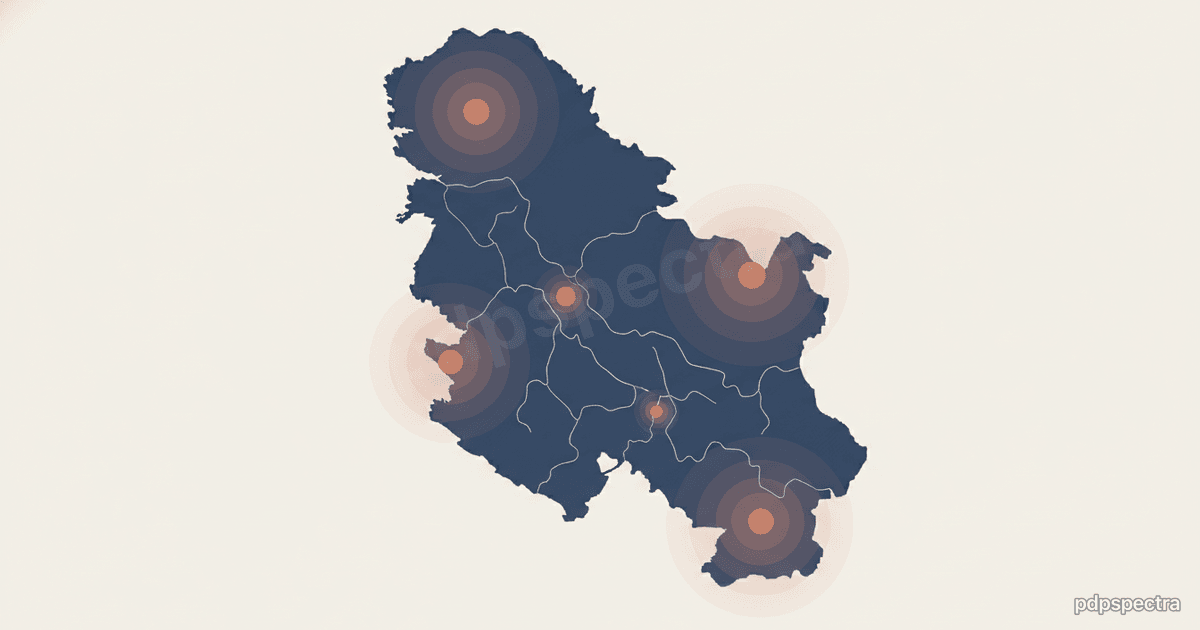
Belgrade concentrates the largest share of Serbian AI activity — Microsoft’s development center, the majority of services firms, banking HQs, gaming studios, and government. Novi Sad is the strong second anchor, with BioSense, a deep IT services and product scene, and the University of Novi Sad. Nis in the south anchors a growing IT services cluster around the Faculty of Electronic Engineering. Kragujevac anchors the automotive cluster and a growing engineering scene. The rest of the country lags on AI density, though the broader Vojvodina plain participates in the agritech story.
Policy and regulatory framework#
Serbia’s AI rules are increasingly EU-aligned even though the country is outside the union. The accession process has driven adoption of GDPR-aligned data protection, alignment with the EU AI Act direction, and harmonization with EU sectoral rules in banking and telecom. Domestic enforcement runs through the Commissioner for Information of Public Importance and Personal Data Protection. The Office for IT and eGovernment, the Council for AI, plus the AI ethics guidelines published in 2023 are the main national-policy instruments. The Institute for AI Research Serbia, established in 2021, anchors public research.
What’s distinctive about Serbia’s AI trajectory#
Three features set Serbia apart. First, the Microsoft development-center presence over more than two decades has produced a senior engineering pool that punches above country size on AI and broader systems work. Second, the post-2022 inflow of Russian and Belarusian engineers, including senior AI and ML talent, has been one of the largest in the Western Balkans and has added genuine depth, even as the political picture remains complicated. Third, the BioSense agritech cluster gives Serbia a research-to-industry anchor in a sector that matters enormously for the country and where AI value is concrete and measurable.
Where pdpspectra fits#
Our Serbia-relevant work centers on cross-border AI and LLM integration for services and product organizations, data engineering for bank and agritech platforms, and DevOps and CI/CD for distributed nearshore teams.
Related reading: AI impact in Croatia, AI impact in Poland, and AI impact in Germany for a peer-market view.
Serbia is a deep, talent-dense Western Balkans AI market in 2026. Talk to our team about your Serbian AI deployment plan.