Photonic Computing: Doing AI Math with Light
Optical neural networks do matrix-multiply with light. What Lightmatter and peers shipped, where photonics fits the AI stack, and the real limits.

Matrix multiplication is the entire ballgame for deep learning. Every transformer layer, every convolution, every attention head reduces to multiplying big matrices together. So the obvious question, asked for decades, is whether you can do that multiply faster and cheaper in some substrate other than switching transistors. Light is the most seductive answer. Photons do not dissipate energy crossing a chip, they do not interfere with each other the way electrons do, and a single waveguide can carry many wavelengths at once. In 2026 photonic computing has finally produced silicon that runs real neural networks — so it is worth being precise about what works and what does not.
How you multiply with light#
There are a few ways to compute a matrix-vector product optically, but they share a principle: encode numbers in properties of light, then let optics do the arithmetic for free as the light propagates.
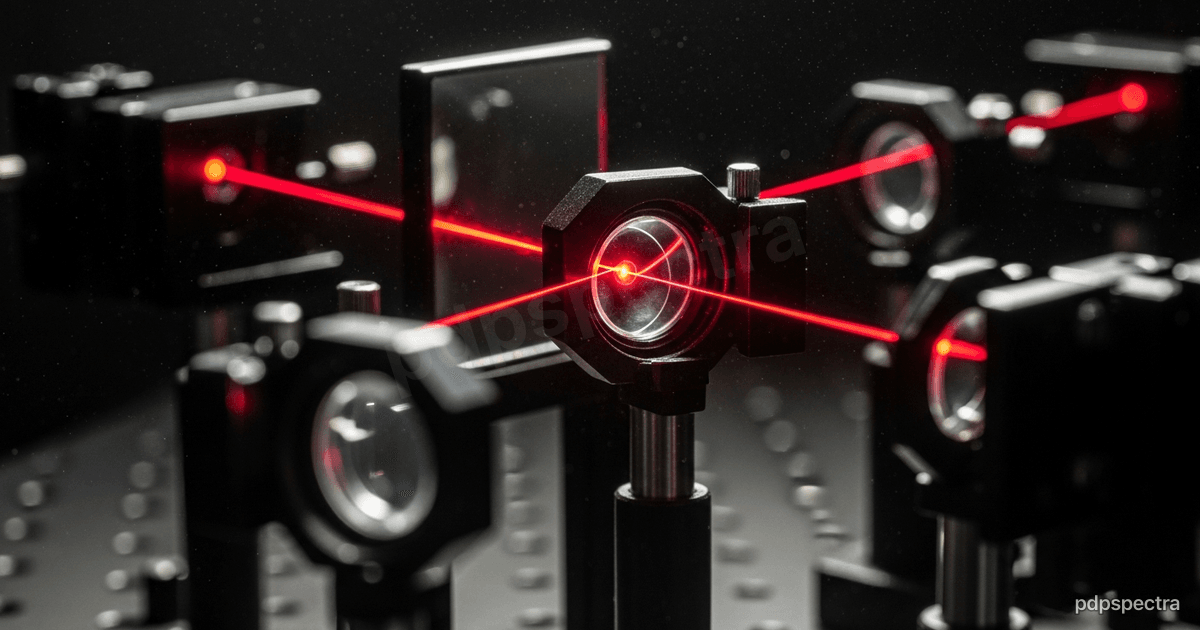
Encode your input vector as the amplitudes of light in a set of waveguides. Pass that light through a mesh of programmable interferometers — typically Mach-Zehnder interferometers, tunable elements that split and recombine beams with controllable phase. A correctly configured mesh performs an arbitrary linear transformation on the input as the light passes through it. Photodetectors at the output convert the resulting optical amplitudes back to electrical signals. The matrix multiply happens at the speed of light propagating across the chip, and the static mesh consumes no dynamic energy per operation the way a transistor array does. A Nature review of photonic matrix multiplication covers the main encoding schemes.
The appeal compounds with wavelength-division multiplexing: run many wavelengths down the same waveguide simultaneously and you compute on all of them in parallel, for free, in the same hardware. That parallelism, plus the absence of a memory-bus shuffle for the linear algebra, is the whole reason anyone bothers with the considerable difficulty of building optical computers.
What Lightmatter actually built#
Lightmatter is the company that moved photonic AI from physics demos toward systems. Two products define their approach, and they are aimed at different problems.
Envise is the compute part — a photonic AI accelerator that performs matrix multiplication with light. Per the reporting around the product, it pairs photonic matrix units with electronic memory and control, using each substrate for what it is good at: light for the massive linear algebra, electrons for memory and nonlinearity. It is described as the first general-purpose photonic AI accelerator, able to run a range of networks including language models.
Passage is the more pragmatic bet, and arguably the nearer-term winner. It is a photonic interconnect — an optical I/O platform that moves data between chips, memory, and servers at rates electrical wires struggle to reach. As models scale across many accelerators, the interconnect, not the compute, often becomes the wall. Photonics for moving bits is a less exotic, more immediately bankable application than photonics for the math itself.
The result that changed the conversation came in April 2025. Lightmatter published universal photonic AI acceleration in Nature, demonstrating a photonic processor that ran ResNet and BERT “out of the box” — reaching accuracy close to 32-bit floating-point digital systems without fine-tuning or quantization-aware training. The hardware vertically stacked six chips in one package: four 128 by 128 photonic tensor cores plus two digital control interfaces. It performed tens of trillions of adaptive block-floating-point operations per second while drawing 78 watts of electrical power and 1.6 watts of optical power. Physics World’s coverage frames the significance well: photonic chips matching electronic counterparts on real models is the threshold the field had been chasing.
That phrase — without modifications — is the load-bearing one. Earlier optical demos ran toy networks or needed the model bent to fit the hardware. Running stock ResNet and BERT at near-FP32 accuracy is the difference between a physics result and a computer.
The peers, briefly#
Lightmatter is not alone. Lightelligence and Celestial AI work the same broad space, the latter heavily focused on optical interconnect and memory disaggregation. Academic groups continue to push raw numbers: a Si3N4 microcomb-driven hyperdimensional photonic accelerator and various tiled silicon-photonic engines have reported throughput in the hundreds of TOPS in lab settings. Treat lab TOPS figures with caution — they often exclude the electronic conversion and control overhead that dominates a real system — but the direction is consistent across multiple independent groups.
The honest limits#
Photonic computing has three structural problems that no amount of optimism erases, and you should weigh them before believing any roadmap.
Optics is great at linear algebra and bad at everything else#
A photonic mesh does linear transforms beautifully. But neural networks need nonlinearities — the activation functions between layers — and those are hard to do in the optical domain. Current systems convert back to electronics for the nonlinearity, then back to light for the next linear layer. Every one of those round trips burns energy and time in the DACs, ADCs, and modulators. The optical multiply may be nearly free, but the electro-optic and opto-electric conversions around it are not, and they frequently dominate the system power budget.
Precision and noise#
Like analog electronics, analog optics is noisy. Laser intensity fluctuates, detectors add shot noise, thermal drift detunes the interferometers, and fabrication variation means no two meshes are identical. Holding a stable, calibrated linear transform across a hot chip is an ongoing control problem, not a one-time setup. The Lightmatter Nature result is impressive precisely because it tamed enough of this to hit near-FP32 accuracy — but that took adaptive block-floating-point encoding and careful calibration, not raw optics.
Integration and cost#
Lasers, modulators, and precision waveguides are not cheap, and packaging photonics with electronics — getting fibers and light onto a die next to transistors — is a hard, low-yield manufacturing problem. The ecosystem around CMOS accelerators is enormous and mature; photonics is comparatively artisanal. That gap shows up directly in cost per part and in the engineering effort to deploy one.
The conversion overhead, quantified in principle#
It is worth making the nonlinearity problem concrete, because it is the single biggest reason optical compute has not displaced silicon. A neural network is a stack of alternating linear and nonlinear steps. Photonics handles the linear step — the matrix multiply — almost for free. But between every pair of linear layers sits an activation function, and there is no practical, low-energy way to apply most activation functions purely in light. So the data round-trips: light into photodetectors, electrical signal through an ADC, the nonlinearity applied digitally, the result pushed back through a DAC and a modulator to re-encode it as light for the next layer.
Each of those conversions costs energy and latency, and they happen at the boundary of every layer. A deep network has many layers, so the conversion overhead is not a one-time tax — it recurs throughout the forward pass. The optical multiply can be nearly free and the system still loses, if the converters dominate. This is why the meaningful efficiency comparison is always at the system level, including modulators, detectors, and data converters, not at the level of the optical core alone. Lab figures that quote only the photonic tensor core’s throughput are measuring the cheapest part of the machine.
The architectural implication is that photonics rewards designs that maximize the work done per conversion: large matrices, high batch sizes, and wavelength parallelism that does many multiplies per trip through the optics. It punishes small, latency-sensitive, frequently-converted workloads. That single observation predicts where optical compute will and will not land better than any TOPS number.
Where photonics fits the AI stack#
Put the pieces together and a clear picture emerges, and it is not “optical computers replace GPUs.”
The nearest, surest win is interconnect. Moving data between accelerators and memory at optical rates addresses a bottleneck that is already biting at scale, and it does not require solving the nonlinearity problem at all. Expect optical I/O in data centers well before optical compute is mainstream.
The compute win is real but narrower: large, batched, latency-tolerant matrix multiplication in a data-center setting, where the per-multiply energy savings can amortize the conversion overhead and the capital cost. That is inference at scale for large models — not edge devices, where the laser and conversion overhead make no sense.
For the AI implementation and Data Platforms work we do, photonics is not yet a component you design into a system — it is a substrate to track. The discipline that matters is the same one we apply across exotic hardware: be precise about which operation is actually your bottleneck. If it is data movement between accelerators, optical interconnect is arriving. If it is the matmul itself at data-center scale, photonic compute is worth watching. If you are running inference at the edge or serving a Hospital Management System’s models on commodity cloud, conventional silicon remains the right call by a wide margin.
Photonic computing in 2026 crossed a real threshold: it runs standard networks at competitive accuracy. That is a genuine milestone and a credit to a hard decade of engineering. It is also not, yet, a reason to rearchitect your stack around light.
Trying to figure out whether your scaling wall is compute or interconnect? That answer decides everything downstream. Talk to our architecture team.