AI Impact on Slovakia: Jobs and Industries in 2026
Slovakia's AI economy in 2026 is shaped by Europe's densest automotive cluster, ESET's cybersecurity heritage, and a manufacturing belt under wage pressure.

Slovakia in 2026 is a 5.4-million-person EU and eurozone economy whose AI position is defined more by industrial structure than by software. The country has the highest cars-per-capita output in the world by a clear margin, four major OEM assembly plants and a deep Tier-1 and Tier-2 supplier base, a meaningful cybersecurity heritage anchored by ESET, and a services and product layer that has grown quietly around Bratislava and Kosice. EU structural funds, eurozone monetary stability, and a younger demographic profile than neighboring Hungary or Czechia give Slovakia a real, if narrow, window to climb the AI value chain before wage convergence closes the cost gap.
This post walks through Slovakia’s AI impact sector by sector, then the workforce, geography, and policy picture.
Sector-by-sector impact#
Automotive — Europe’s densest cluster#
Automotive is the spine. Volkswagen Bratislava, Stellantis in Trnava previously PSA, Kia in Zilina, and Jaguar Land Rover in Nitra are the four anchors, supported by a dense Tier-1 and Tier-2 base — Continental, Schaeffler, ZF, Magna, Faurecia, Hella, Brose, Plastic Omnium, plus local firms like Matador. AI deployment is concentrated in vision-based quality inspection, predictive maintenance, energy and water optimization, logistics scheduling, and the slow transition into EV-specific testing and battery diagnostics. The EV shift is the single biggest threat and opportunity — VW Bratislava’s Trinity-related programs, JLR’s electrification roadmap, and the new battery investments in the broader Central European corridor are reshaping what the supplier base needs to do.
Cybersecurity and the ESET cluster#
ESET, headquartered in Bratislava, is one of the few European cybersecurity firms with genuine global scale, and its presence has seeded a wider security ecosystem in the country. AI in malware detection, telemetry analysis, threat hunting, and consumer endpoint protection is core to the product. Around ESET sit a cybersecurity-services layer — Aliter Technologies, Binary Confidence, Citadelo, plus the local operations of global integrators — and a steady pipeline of security-trained engineers out of the Slovak University of Technology in Bratislava and the Technical University of Kosice.
IT services and shared-service centers#
Slovakia is a meaningful shared-service-center destination, particularly for German, Austrian, Swiss, and Nordic buyers. Deutsche Telekom IT Solutions, IBM, Accenture, AT and T, Dell, Adastra, Soitron, and Lenovo have substantial Bratislava and Kosice operations. AI copilots in finance, HR, procurement, and IT operations have meaningfully changed productivity in these centers and pushed roles up the value chain. The product layer — Sygic in navigation, Pixel Federation in gaming, Sli.do which is now part of Cisco, Slovak Telekom’s product arm, Eset’s broader portfolio — is smaller than Czechia’s but real.
Flying-car and aerospace adjacencies#
AeroMobil, headquartered near Bratislava, has been the country’s most-visible deep-tech bet for over a decade and continues to develop its flying-car program through certification work, while the wider aerospace adjacency includes Spirit AeroSystems, the Sliac repair operations, and a smaller drone and UAV scene. AI in flight-control software, simulation, and structural analysis is in development rather than mass deployment, but the talent base it cultivates is broader than the immediate product.
Banking and financial services#
Slovak banking is concentrated and largely foreign-owned — Slovenska Sporitelna under Erste, VUB under Intesa Sanpaolo, Tatra Banka under Raiffeisen, plus CSOB, UniCredit Bank Slovakia, and the state-owned SZRB. AI in fraud, AML, conversational support in Slovak, and underwriting is in production. The eurozone membership has kept the operating environment stable and freed engineering capacity for AI rather than currency-related work.
Steel, machinery, and traditional manufacturing#
US Steel Kosice — now under the Slovak state’s strategic agreement following the GFG Alliance turbulence — is the country’s largest steel operation and runs AI in mill optimization, energy management, and product-quality work. Around it sit machinery and component makers — SES Tlmace, Continental Matador, Whirlpool, plus the broader chemicals and pharma footprint at Slovnaft and Zentiva — that are running predictive maintenance and process AI.
Job categories growing and shrinking#
| Role | Direction | Driver |
|---|---|---|
| AI and ML engineers | Strongly growing | OEM and security expansion |
| Data and platform engineers | Strongly growing | Bank and SSC modernization |
| EV and battery engineers | Strongly growing | OEM electrification |
| Cybersecurity analysts | Strongly growing | ESET cluster and threat pull |
| BPO and shared-service agents | Declining | Copilot and deflection |
| Mid-level translators | Declining | Generative tooling |
| Junior QA | Declining | Test automation |
| Automotive technicians | Stable, upskilling | Vision and predictive maintenance |
| Engineering simulation specialists | Growing | EV and aerospace pull |
Geographic distribution within the country#
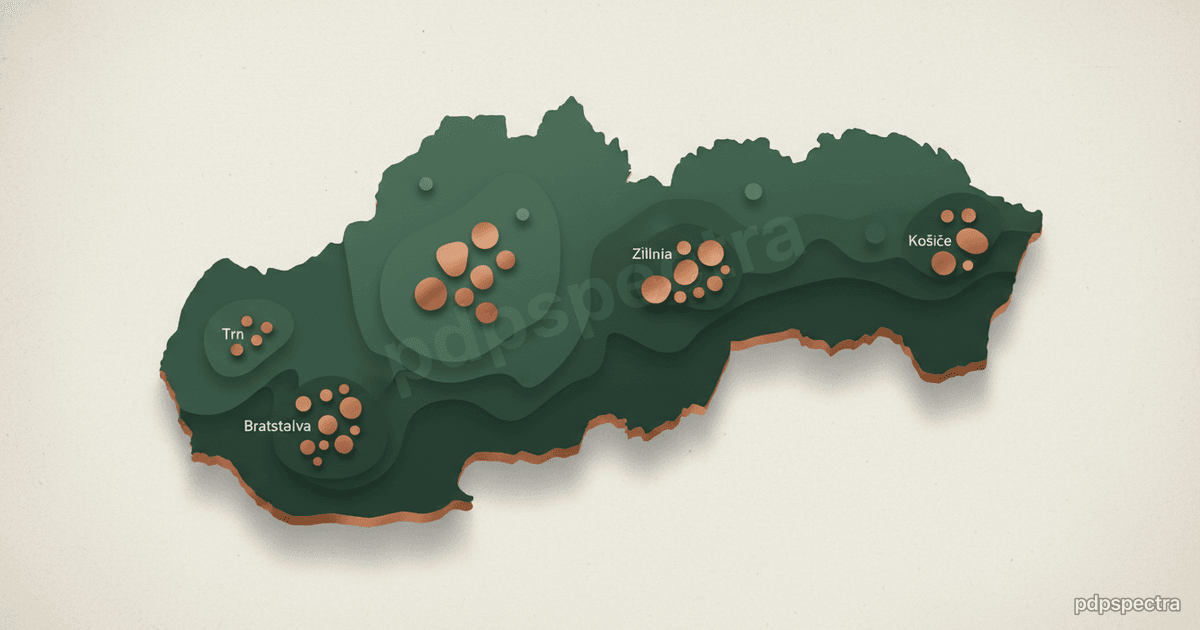
Bratislava concentrates the largest share of Slovak AI activity — banking HQs, ESET, shared-service centers, the VW plant on the outskirts, plus most of the venture-backed startups. Kosice is the strong second anchor in the east, with Deutsche Telekom IT Solutions, the Technical University, a real product scene, and US Steel. Zilina around Kia and the University of Zilina anchors the northwest. Trnava and Nitra anchor the central-west around Stellantis and JLR. The east and south outside Kosice lag on AI density, though the manufacturing footprint reaches widely.
Policy and regulatory framework#
Slovakia’s AI rules sit inside the EU framework. The EU AI Act, GDPR, the Data Act, and the Digital Services Act are the primary instruments, enforced locally by the Office for Personal Data Protection. National AI policy runs through the Ministry of Investments, Regional Development and Informatization and the National Strategy for Digital Transformation. EU structural and recovery funds are the dominant public funding channel. The Slovak Academy of Sciences and the Slovak University of Technology in Bratislava are the main research anchors.
What’s distinctive about Slovakia’s AI trajectory#
Three features set Slovakia apart from peer CEE markets. First, the cars-per-capita lead means industrial AI demand is concentrated and demanding — vision, predictive maintenance, and energy optimization use cases sit alongside the slow but consequential EV transition. Second, the ESET heritage gives Slovakia a credible cybersecurity-AI specialism that is rare for a country of this size and that pulls security-aware engineers into adjacent industrial and fintech work. Third, eurozone and Schengen membership combined with EU recovery funds have created a stable operating environment that lets industrial buyers commit to multi-year AI programs rather than improvising year by year.
Where pdpspectra fits#
Our Slovakia-relevant work centers on industrial AI and LLM integration for automotive and supplier operators, data engineering for bank and SSC modernization, and DevOps and CI/CD for cross-border product organizations.
Related reading: AI impact in Poland, AI impact in Germany, and AI impact in Croatia for a peer-market view.
Slovakia is a small, industrially focused EU AI market in 2026. Talk to our team about your Slovak AI deployment plan.