AI Impact on Slovenia: Jobs and Industries in 2026
Slovenia's AI economy in 2026 is shaped by Outfit7's gaming, Iskratel's telecom, manufacturing strength, and an engineering-dense small economy at the EU's Alpine edge.

Slovenia in 2026 is a 2.1-million-person Alpine EU and eurozone economy that consistently outperforms its size in engineering output. GDP per capita is solidly above the EU average, the export share is among the highest in Europe, and the country has a tradition of producing technically demanding products — pharmaceuticals at Krka and Lek, electric motors at Mahle Letrika, ski equipment at Elan, kitchen appliances at Gorenje under Hisense — that has now translated into a credible if narrow AI ecosystem. The headline names — Outfit7 in mobile gaming, the historical Bitstamp origins, Iskratel in telecom — sit on top of a wider manufacturing and engineering base that is steadily absorbing AI as a default capability.
This post walks through Slovenia’s AI impact sector by sector, then the workforce, geography, and policy picture.
Sector-by-sector impact#
Mobile gaming, consumer apps, and product#
Outfit7, headquartered in Ljubljana and owned by Chinese gaming group Zhejiang Jinke Tom Culture since 2017, remains the country’s most-visible consumer product, with the Talking Tom franchise as a long-running mobile-gaming success. AI deployment sits in live-ops — matchmaking, churn, content personalization, fraud, and player support automation — and increasingly in the creative pipeline. Around Outfit7 sits a smaller but real product layer — Bitstamp which originated in Slovenia before relocating its center of gravity to Luxembourg and the UK, Celtra in creative-automation, Databox in analytics, plus a long tail of B2B SaaS firms — that has made AI features default.
Telecom and networking#
Iskratel, headquartered in Kranj and now part of S and T Group under Kontron, is the country’s most-historically-significant telecom-equipment vendor and has carried networking and telco-software expertise across decades of consolidation. Around it sits a broader networking and telco operations layer including Telekom Slovenije, A1 Slovenija, T-2, and Telemach Slovenija that has deployed AI in network optimization, fault prediction, and customer operations.
IoT, sensors, and industrial electronics#
The Hyper IoT cluster, plus a wider Slovenian sensor and industrial-electronics scene including Iskra, ETI, Kolektor, and Domel, has positioned the country as a quiet supplier of embedded and industrial-AI components into the broader European value chain. AI at the edge — vision modules on production lines, motor-control firmware, smart-grid endpoints — is the natural fit, and Slovenian firms are well placed in that segment.
Pharma and life sciences#
Krka and Novartis-owned Lek, both headquartered in Slovenia, are the country’s two pharma anchors and together make pharmaceuticals one of Slovenia’s largest export categories. AI in clinical operations, manufacturing quality, regulatory documentation, and increasingly molecular discovery is in production rather than pilot. Around the two anchors sits a smaller biotech and contract-research layer that benefits from spillover talent.
Automotive supply, machinery, and white goods#
Slovenia is a meaningful Tier-1 and Tier-2 automotive supplier into the German, Italian, and French OEM bases. Mahle Letrika in electric motors, Kolektor in commutators and broader mechatronics, Hidria in components and fluid dynamics, Cimos previously and TAB Tovarna Akumulatorskih Baterij in batteries are the named players. AI in vision quality, predictive maintenance, and energy optimization is in production. Gorenje under Hisense ownership remains the country’s largest white-goods operator and is similarly AI-aware.
Banking and financial services#
Slovenian banking is concentrated and partially state-owned — NLB which is the largest, NKBM under OTP, Intesa Sanpaolo Bank Slovenia under SKB, Unicredit Banka Slovenija, plus the public SID Banka. AI in fraud, AML, conversational support in Slovene, and underwriting is in production. The eurozone membership keeps the operating environment stable and frees engineering capacity for AI rather than currency work.
Logistics and the Port of Koper#
The Port of Koper is the country’s only major container port and a steady AI buyer in vessel scheduling, container routing, customs documentation, and emissions reporting. Around it sits a logistics-services cluster, plus the rail-freight operations that connect Koper to the wider Central European corridor.
Job categories growing and shrinking#
| Role | Direction | Driver |
|---|---|---|
| AI and ML engineers | Strongly growing | Gaming, IoT, manufacturing |
| Data and platform engineers | Strongly growing | Pharma and bank modernization |
| Embedded-systems engineers | Growing | Industrial IoT pull |
| Cybersecurity analysts | Strongly growing | EU and threat environment |
| BPO and shared-service agents | Declining | Copilot and deflection |
| Mid-level translators | Declining | Generative tooling |
| Junior QA | Declining | Test automation |
| Pharma manufacturing technicians | Stable, upskilling | Quality AI |
| Machinery technicians | Stable, upskilling | Vision and predictive maintenance |
Geographic distribution within the country#
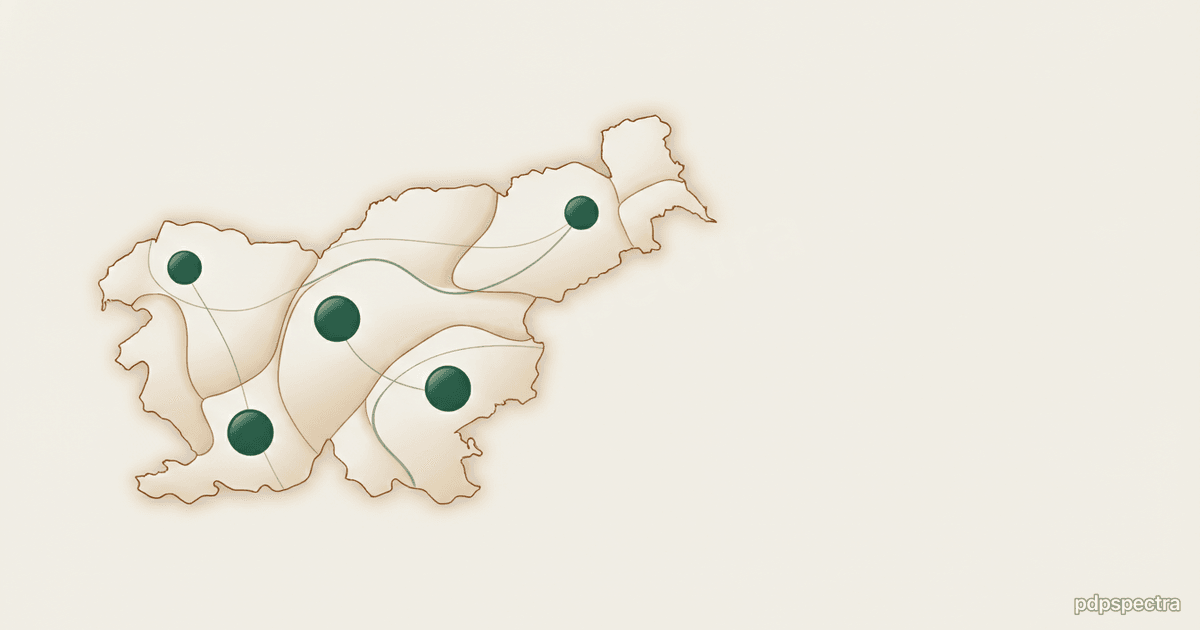
Ljubljana concentrates the largest share of Slovenian AI activity — banking HQs, government, the product cluster around Outfit7, plus the University of Ljubljana and the Jozef Stefan Institute. Maribor is the strong second anchor with the University of Maribor, automotive supply, and a real product scene. Kranj anchors the northwest around Iskratel and a wider engineering cluster, with proximity to Bled and the Alpine corridor. Koper anchors the coast and the port. Celje, Novo Mesto around Krka, and Murska Sobota round out the picture. The geographic concentration is unusually flat for a small country, partly because Slovenia is small enough that commuting and remote work largely erase the urban-rural divide.
Policy and regulatory framework#
Slovenia’s AI rules sit inside the EU framework. The EU AI Act, GDPR, the Data Act, and the Digital Services Act are the primary instruments, enforced locally by the Information Commissioner. National AI policy runs through the Ministry of Digital Transformation and the National Programme for AI NpUI. The International Research Centre on AI under UNESCO auspices is hosted in Ljubljana and is one of the country’s distinctive policy assets. EU structural and recovery funds are the dominant public funding channel.
What’s distinctive about Slovenia’s AI trajectory#
Three features set Slovenia apart. First, the engineering-per-capita density is exceptional for a country of this size — the Jozef Stefan Institute alone has a multi-decade publication record in AI and machine learning that punches well above the country’s headcount. Second, the export-heavy economy means Slovenian AI adopters tend to think in cross-border supply-chain terms by default, which keeps standards and interoperability high. Third, the UNESCO AI centre and a generally constructive small-state diplomatic posture have given Slovenia an outsized voice in EU and global AI-ethics conversations.
Where pdpspectra fits#
Our Slovenia-relevant work centers on industrial AI and LLM integration for pharma and machinery operators, data engineering for bank and retail platforms, and ML and MLOps for product organizations scaling AI features.
Related reading: AI impact in Croatia, AI impact in Italy, and AI impact in Germany for a peer-market view.
Slovenia is a small, engineering-dense Alpine AI market in 2026. Talk to our team about your Slovenian AI deployment plan.