AI Impact on Ukraine: Jobs and Industries in 2026
Ukraine's AI economy in 2026 is led by a wartime defense-tech surge, distributed-team resilience, and a global IT services and product base proven under the worst conditions.

Ukraine in 2026 is, against every external prediction made in 2022, a functioning and increasingly assertive AI economy. The headline angle for any honest 2026 read is the defense-tech surge and the distributed-team resilience that has kept the wider IT services and product industries operating — and in many segments growing — through nearly four years of full-scale war. Brave1, the joint government-MOD-private defense-tech coordination platform launched in 2023, has stood up an ecosystem of hundreds of certified drone, electronic-warfare, robotics, and software suppliers, with AI as the connective tissue across targeting, navigation, autonomy, and intelligence. At the same time, Ukrainian engineers have continued to ship product for global customers from Lviv, Kyiv, Dnipro, and from cross-border bases in Warsaw, Krakow, Wroclaw, Tallinn, and Lisbon.
This post walks through Ukraine’s AI impact sector by sector, then the workforce, geography, and policy picture.
Sector-by-sector impact#
Defense tech — the wartime headline#
Defense tech is the dominant 2026 story. Brave1 has formalized what was, in 2022 and 2023, a frantic improvisation of garages and volunteers into a structured cluster with grant funding, procurement pathways into the Armed Forces of Ukraine, and an export track that allies are increasingly interested in. AI sits across the stack — computer-vision targeting on small drones, autonomous terminal guidance, swarm coordination, EW countermeasures, intelligence fusion from heterogeneous sensors, plus operational-software AI for command-and-control. The number of certified suppliers has risen from a handful in 2022 into the multiple hundreds in 2026, and the AFU has effectively become the world’s most demanding live test environment for tactical AI. The lessons are flowing back into civilian software, hardware, and operational practice across the country.
IT services and product — distributed-team resilience#
The wider Ukrainian IT industry is the second story and the older one. Grammarly, GitLab — both of which trace meaningful engineering roots to Kyiv — MacPaw, Reface now Neocortext, People.AI, Preply, Petcube, Restream, Allset, Awesomic, Headway, and a long tail of B2B and consumer SaaS firms have continued to operate through the war with a combination of in-country teams in safer western and central regions and distributed teams across the EU. The IT services layer — EPAM with deep Ukrainian roots, SoftServe, Ciklum, GlobalLogic now part of Hitachi, Sigma Software, Intellias, N-iX, plus a wider mid-market — has retained the great majority of its Ukrainian engineering base and added EU footprints to maintain continuity. AI copilots in engineering, customer support, and operations are universal across this set, and the export of AI-enabled services to North American and Western European customers has continued to grow.

Agritech and food#
Agriculture has remained a pillar of the Ukrainian economy through the war. Kernel, MHP, Astarta, Nibulon, and the wider grain-and-protein cluster have continued to operate, with AI in yield forecasting, equipment management, logistics routing under wartime constraints, and remote-sensing for field monitoring. Around them sits an agritech-startup layer that has built on the Black Sea grain-corridor data and the operational pressure to do more with reduced labor.
Public-sector and digital state#
The Diia platform, launched in 2020 and accelerated dramatically through wartime needs, is one of the most-functional digital-state platforms anywhere. AI is in document processing, fraud detection, citizen-services routing, and increasingly in the integration of veteran-services, displaced-persons, and reconstruction workflows. The Ministry of Digital Transformation has been the most-visible government department of the war and a major AI-deployment customer in its own right.
Energy, infrastructure, and reconstruction#
The energy sector — Naftogaz, DTEK, Ukrenergo, Energoatom — has spent the war in continuous emergency-management mode and has accelerated AI deployment in grid management, fault prediction, and demand forecasting under conditions that simply do not exist elsewhere. The reconstruction question, with hundreds of billions of euros of damage assessed by the World Bank and partners, is a multi-year AI-relevant program in its own right — survey AI, construction-management AI, and program-finance AI are all in early deployment.
Banking and financial services#
Ukrainian banking has been a quiet wartime success story. PrivatBank, Oschadbank, Raiffeisen Bank Ukraine, Sense Bank, plus Monobank as the dominant digital-bank brand, have kept services running through every phase of the war and are AI-heavy in fraud, AML, conversational support in Ukrainian, and underwriting. Monobank in particular is widely studied as a wartime fintech case.
Job categories growing and shrinking#
| Role | Direction | Driver |
|---|---|---|
| Defense-tech engineers | Strongly growing | Brave1 and AFU pull |
| AI and ML engineers | Strongly growing | Services, product, defense |
| Drone and robotics engineers | Strongly growing | Wartime demand |
| Cybersecurity analysts | Strongly growing | Threat environment |
| Distributed-team operations leads | Growing | Cross-border resilience |
| BPO and shared-service agents | Declining | Copilot and deflection |
| Mid-level translators | Declining | Generative tooling |
| Junior QA | Declining | Test automation |
| Agricultural operators | Stable, upskilling | Sensing and routing AI |
Geographic distribution within the country and the diaspora#
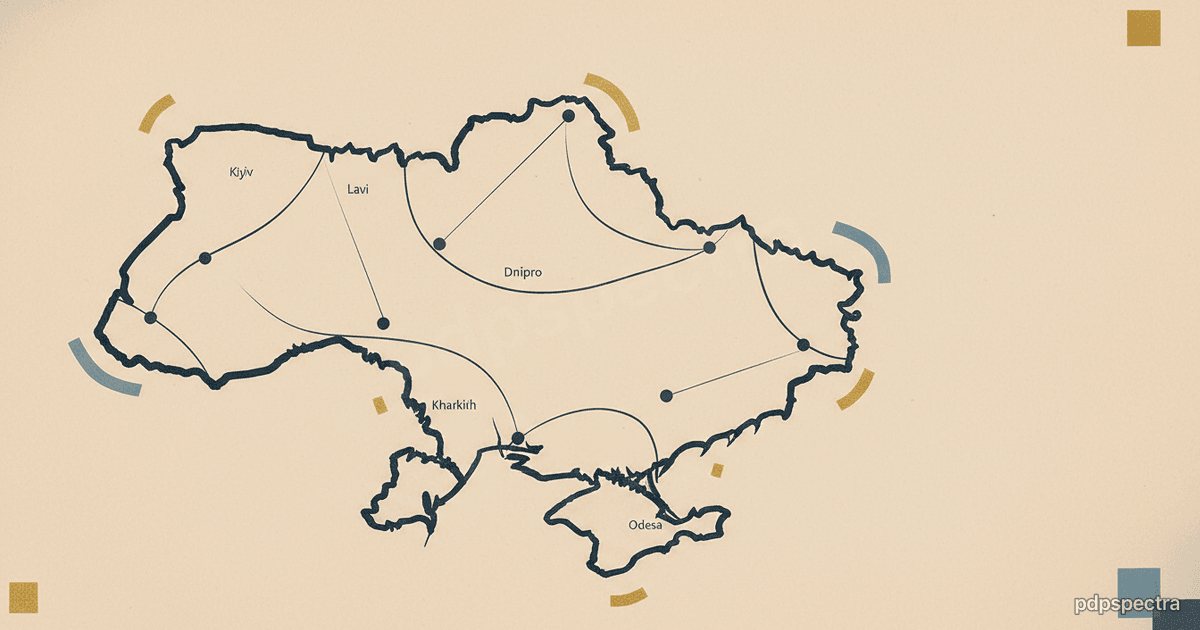
Kyiv remains the country’s largest AI cluster despite the war, with the broader Kyiv region anchoring government, banking, defense-tech coordination, and the largest concentration of product and services firms. Lviv has emerged as the most-active western anchor, hosting a meaningful share of relocated engineering and a growing defense-tech presence. Dnipro, with its strong technical-university heritage, has become a defense-tech hub of its own. Kharkiv, despite proximity to the front, retains a real engineering base in software and hardware. Odesa anchors the south and the maritime AI work. A meaningful share of Ukrainian engineering now operates from Warsaw, Krakow, Wroclaw, Tallinn, Vilnius, Riga, Lisbon, Berlin, and London — the country’s effective AI footprint is now larger than its physical borders.
Policy and regulatory framework#
Ukraine’s AI rules are converging with the EU framework as the candidate-country accession process advances. The EU AI Act, GDPR-aligned data protection, and the Digital Services Act are the reference instruments. The Ministry of Digital Transformation coordinates national AI policy, with the AI roadmap initially published in 2020 and extensively revised through the wartime period. The Brave1 platform is the most-consequential defense-AI coordination instrument. Ukraine’s status as a credible EU candidate and the volume of EU and bilateral support funding have created a stable rules-direction even under wartime conditions.
What’s distinctive about Ukraine’s AI trajectory#
Three features set Ukraine apart from every other European AI market. First, the country is running the world’s largest live test of tactical AI under genuine adversarial conditions, and the operational data and lessons that flow back into civilian product are not available anywhere else. Second, the distributed-team resilience demonstrated since 2022 has reset what global customers consider possible from a partner operating under war — Ukrainian firms have continued to ship through blackouts, mobilization, and infrastructure attacks, and the practical AI-ops patterns developed in response are exportable. Third, the reconstruction program, when it accelerates, will be the largest AI-relevant rebuild project in European history and will pull AI demand into infrastructure, finance, public services, and labor markets simultaneously.
Where pdpspectra fits#
Our Ukraine-relevant work centers on distributed-team AI and LLM integration for product and services organizations, data engineering for cross-border data platforms, and cloud infrastructure work for teams operating across EU jurisdictions under continuity pressure.
Related reading: AI impact in Poland, AI impact in Estonia, and AI impact in Germany for a peer-market view.
Ukraine is the most operationally tested AI market in Europe in 2026. Talk to our team about your Ukrainian or distributed-team AI deployment plan.