AI Impact on Estonia: Jobs and Industries in 2026
Estonia's AI economy in 2026 is led by an AI-first government posture on X-Road, an outsized startup output, and an e-Residency-driven cross-border digital state.

Estonia in 2026 is the clearest example anywhere of a small state that built a digital operating system before the AI wave arrived, and is now compounding the advantage. The country’s headline angle is the AI-first government posture on X-Road, the secure data-exchange backbone that connects more than 3,000 public and private services and that has now become the substrate for AI deployment across the public sector. With roughly 1.4 million people, Estonia cannot win AI on volume, so it wins on architecture. The Kratt strategy, named after the Estonian folkloric construct, is the most explicit AI policy framework in Europe and treats individual ministries as AI-deploying organizations by default.
This post walks through Estonia’s AI impact sector by sector, then the workforce, geography, and policy picture.
Sector-by-sector impact#
Digital government on X-Road#
X-Road is the structural lead. Built since the early 2000s and now exported through the Nordic Institute for Interoperability Solutions to dozens of partner countries, it is the layer on which Estonian AI deployments sit. The Bürokratt program, a network of public-sector AI assistants that share intent and routing across ministries, has expanded from a citizen-services pilot into tax, health, education, and unemployment workflows. The Health Information System runs AI for clinical decision support across public hospitals. The Tax and Customs Board has been an AI-forward enforcement organization for years. Document AI in the courts and registries is in production rather than pilot.
Fintech and mobility#
The Estonian startup output relative to population is the second story. Bolt, headquartered in Tallinn, is one of Europe’s largest mobility and delivery platforms and runs heavy AI in pricing, dispatch, fraud, and driver onboarding. Wise, founded by Estonians and listed on the London Stock Exchange, retains deep engineering in Tallinn and is an AI-heavy operator in cross-border payments. Veriff, ID-verification at scale, is essentially an AI company. Pipedrive, owned by Vista since 2020, is folding AI into the CRM core. Skeleton Technologies, Starship Technologies, and a long tail of B2B SaaS round out the picture.
e-Residency and the cross-border digital state#
e-Residency, launched in 2014 and now with well over 100,000 e-residents from more than 170 countries, is the most distinctive Estonian export. The program has grown from a curiosity into a real cross-border platform for company formation, banking access, and tax administration, and AI now sits inside the e-Residency onboarding, KYC, and ongoing-compliance flows. Around the program has grown a service-provider ecosystem — Xolo, Companio, 1Office, LeapIN — that runs AI for bookkeeping, invoicing, and tax filings for distributed founders.
Cybersecurity and defense#
Tallinn hosts the NATO Cooperative Cyber Defence Centre of Excellence, and the Estonian cyber posture — refined since the 2007 attacks — has become a quiet AI-deployment area. CybExer, Cybernetica, Guardtime, and Clarified Security are the named local players. Defense AI investment has risen sharply since 2022 and pulled in drone, signals, and situational-awareness work, with Milrem Robotics’ unmanned-ground-vehicle line as the most-visible product.
Banking and financial services#
The banking sector is concentrated and Nordic-owned — Swedbank, SEB, Luminor, LHV — with AI deployments in fraud, AML, conversational support in Estonian and Russian, and underwriting. LHV in particular has built itself into the dominant banking partner for Estonian and broader European fintechs and runs an AI-forward operations stack.
Manufacturing and logistics#
Estonia is not a heavy industrial economy by EU standards, but the cluster that exists — electronics, machinery, wood products, plus the Port of Tallinn — is steadily modernizing. Krah Pipes, Skeleton Technologies’ ultracapacitor plants in Estonia and Germany, and the broader electronics-contract-manufacturing base are running vision and process AI. Logistics AI sits inside the port and around Bolt’s broader operations.
Job categories growing and shrinking#
| Role | Direction | Driver |
|---|---|---|
| AI and ML engineers | Strongly growing | Startup and public sector |
| Data and platform engineers | Strongly growing | X-Road and fintech |
| Cloud and DevOps engineers | Growing | Cross-border SaaS scaling |
| Cybersecurity analysts | Strongly growing | NATO and defense pull |
| Public-sector service designers | Growing | Bürokratt expansion |
| BPO and shared-service agents | Declining | Copilot and deflection |
| Mid-level translators | Declining | Generative tooling |
| Junior QA | Declining | Test automation |
| Bookkeepers | Stable, upskilling | Generative tooling |
Geographic distribution within the country#
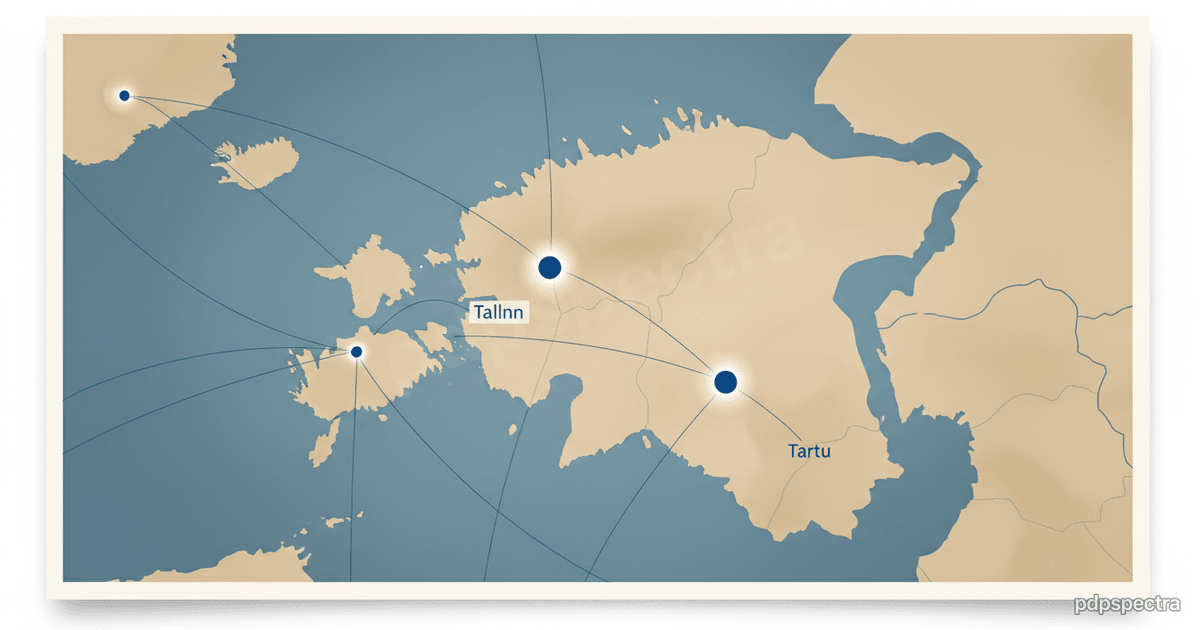
Tallinn concentrates the great majority of Estonian AI activity — government, banking HQs, the startup cluster, plus most of the venture-backed founders. Tartu is the strong second anchor, with the University of Tartu, the Institute of Computer Science, biotech, and a steady flow of research-led startups. Parnu, Narva, and the smaller centers lag on AI density. The remote-work norm and the small physical footprint mean that geographic concentration matters less in Estonia than in almost any other EU country.
Policy and regulatory framework#
Estonia’s AI rules sit inside the EU framework. The EU AI Act, GDPR, the Data Act, and the Digital Services Act are the primary instruments, enforced locally by the Data Protection Inspectorate. National AI policy runs through the Kratt strategy and is coordinated by the Ministry of Economic Affairs and Communications and the Government CIO Office. The Information System Authority RIA is the technical anchor for both cybersecurity and the X-Road substrate.
What’s distinctive about Estonia’s AI trajectory#
Three features set Estonia apart. First, the X-Road substrate means that AI deployments in the public sector inherit a working interoperability layer rather than negotiating one project by project — the speed-to-production is genuinely different. Second, the e-Residency program creates a feedback loop between the Estonian regulatory model and a global distributed founder base, which keeps the AI-relevant rules pragmatic and tested in the real world. Third, the country is small enough that a single policy decision can move the entire stack, which makes Estonia the most useful EU test bed for AI-government patterns that may later scale to larger member states.
Where pdpspectra fits#
Our Estonia-relevant work centers on cross-border AI and LLM integration for digital-state and fintech operators, data engineering for interoperability and KYC pipelines, and DevOps and CI/CD for distributed-team product organizations.
Related reading: AI impact in Finland, AI impact in Poland, and AI impact in Germany for a peer-market view.
Estonia is the most architecturally interesting AI market in Europe in 2026. Talk to our team about your Estonian or cross-border AI deployment plan.