AI Impact on Iceland: Jobs and Industries in 2026
Iceland's AI economy in 2026 is shaped by CCP Games, geothermal-powered data centers, renewable-energy AI, fishing-fleet digitization, and a tiny but distinctive product layer.

Iceland in 2026 is a 390,000-person North-Atlantic economy whose AI position is shaped by physics as much as by policy. Cheap, abundant, and overwhelmingly renewable electricity — geothermal plus hydro — and a cold climate that minimizes cooling costs have made the country one of the most attractive locations in Europe for energy-intensive AI training and high-density data-center operations. On top of that sits a small but globally visible product layer led by CCP Games, a fishing-and-aquaculture industry that has become quietly AI-heavy, and a public sector whose smallness lets new AI patterns ship fast.
This post walks through Iceland’s AI impact sector by sector, then the workforce, geography, and policy picture.
Sector-by-sector impact#
Data centers and AI training capacity#
The data-center anchor is the country’s single most important AI story. atNorth, headquartered in Reykjavik and operating sites at Keflavik and elsewhere in the country plus expansion across the Nordics, has positioned Iceland as a credible European location for AI training and HPC workloads. Verne, previously Verne Global and now owned by Ardian, runs a major site in Keflavik with extensive HPC and AI tenancy. Borealis Data Center and a wave of smaller operators round out the picture. The combination of nearly carbon-free electricity, low average temperatures that cut cooling demand, and stable geopolitical positioning has made the country a destination for European and North American AI training buyers who care about both cost per token and the sustainability story.
Gaming and digital entertainment#
CCP Games, headquartered in Reykjavik and now owned by Pearl Abyss since 2018, remains the country’s most-visible product anchor. EVE Online, in its third decade as a live-service MMO, is a sustained engineering and live-ops platform that has trained a generation of Icelandic engineers in distributed systems, telemetry, fraud, economy design, and increasingly AI for personalization, content tooling, and player support. Around CCP sits a smaller gaming-and-product layer — Solid Clouds, Mainframe Industries previously, plus indie studios — that benefits from the same talent pool.
Renewable energy and grid AI#
The energy sector is the second deepest AI buyer. Landsvirkjun, the state power company, plus ON Power, HS Orka, and Orkuveita Reykjavikur operate one of the most renewable grids in the world and have layered AI onto fault prediction, demand forecasting, and asset optimization across geothermal, hydro, and small wind assets. Carbon-capture and geothermal-direct-use experiments — Climeworks and Carbfix at Hellisheidi, plus the broader CarbFix mineralization program — have made Iceland a test bed for AI-augmented climate-tech operations.
Fishing, aquaculture, and ocean tech#
The fishing industry remains a meaningful share of Icelandic GDP and is one of the most AI-augmented fisheries in the world. Marel — headquartered in Gardabaer and one of Iceland’s largest companies by global headcount, recently merging into JBT Marel — supplies fish, meat, and poultry processing equipment globally and runs heavy AI in vision-based grading, yield optimization, and predictive maintenance. Around Marel sits a wider ocean-tech cluster including Vaki for fish-farm biomass estimation, Hampidjan for fishing gear, plus an aquaculture sector around the fjords that has scaled rapidly and is AI-heavy in feeding, health monitoring, and harvest planning.
Mobility and consumer#
Hopp, headquartered in Reykjavik, is the country’s most-visible micromobility operator and has expanded across Iceland and into selected European markets with AI for fleet management, demand forecasting, and dynamic pricing. Around Hopp sits a smaller consumer-tech layer — Meniga in personal-finance which has more European than Icelandic operations, plus a steady flow of B2B SaaS firms — that benefits from the country’s small home market by exporting from day one.
Financial services#
Icelandic banking is concentrated — Islandsbanki, Landsbankinn, Arion Bank, plus the savings-bank tail — and runs AI in fraud, AML, conversational support in Icelandic, and underwriting. The country’s small size and the post-2008 reorganization have produced a relatively modern banking IT stack that is easier to deploy AI on than the legacy estates in larger markets.
Public sector#
Government digitization runs through the Island.is portal, the Digital Iceland initiative, and Stafraent Island. AI assistants in tax, customs, and citizen services are in production, and the country’s small size means new AI patterns can be tested end-to-end in months rather than years.
Job categories growing and shrinking#
| Role | Direction | Driver |
|---|---|---|
| AI and ML engineers | Strongly growing | CCP, energy, ocean tech |
| Data-center engineers | Strongly growing | atNorth, Verne, broader sites |
| Energy and grid engineers | Growing | Renewable AI pull |
| Aquaculture specialists | Growing | Fjord-farm expansion |
| Game live-ops analysts | Stable | CCP and indie studios |
| BPO and shared-service agents | Declining | Copilot and deflection |
| Mid-level translators | Declining | Generative tooling |
| Junior QA | Declining | Test automation |
| Cybersecurity analysts | Growing | Energy and data-center pull |
Geographic distribution within the country#
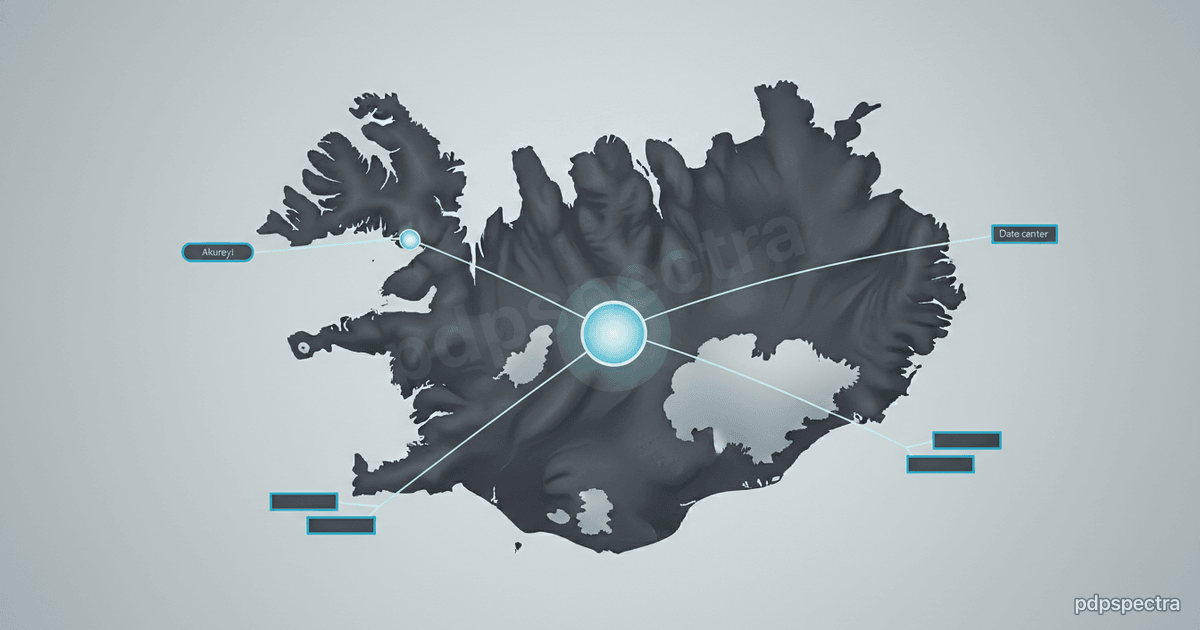
Reykjavik and the surrounding capital region concentrate almost the entire AI activity — government, banking HQs, CCP, the headquarters of atNorth and Marel, and the great majority of startups. Keflavik anchors the data-center cluster and the international airport. Akureyri in the north hosts a small but growing tech and university presence around the University of Akureyri. The fjords and coastal towns participate through fishing, aquaculture, and the energy infrastructure that sits in the country’s interior. The geographic concentration is unusually extreme — more than two thirds of Icelanders live in the capital region, which compresses the AI workforce into a single network.
Policy and regulatory framework#
Iceland’s AI rules sit inside the EEA framework, which means EU rules apply via the EEA Agreement. The EU AI Act, GDPR, the Data Act, and the Digital Services Act are the primary instruments, enforced locally by the Data Protection Authority Personuvernd. National AI policy is coordinated by the Ministry of Higher Education, Science and Innovation, and the Digital Iceland initiative under the Ministry of Finance. The Icelandic Centre for Research RANNIS funds the public research base. The combination of EEA alignment and small-state agility means Iceland is generally a fast follower on EU rules rather than a slow adopter.
What’s distinctive about Iceland’s AI trajectory#
Three features set Iceland apart. First, the renewable-energy abundance combined with the cold climate makes the country one of the few European locations where AI training capacity can be expanded without intensifying carbon or grid constraints, which is becoming a genuine competitive advantage as European buyers tighten sustainability requirements. Second, the live-services depth at CCP and the equipment-AI depth at Marel give the country two globally visible, decades-long platform investments that have trained senior engineers in domains larger countries do not match per capita. Third, the smallness of the public sector and population means new digital and AI patterns can be tested end-to-end against a real economy in timelines that simply do not exist in larger jurisdictions.
Where pdpspectra fits#
Our Iceland-relevant work centers on cloud infrastructure for teams placing AI training and inference workloads in Icelandic and broader Nordic data centers, AI and LLM integration for energy and ocean-tech operators, and data engineering for cross-border telemetry and operations platforms.
Related reading: AI impact in Finland, AI impact in Switzerland, and AI impact in the Netherlands for a peer-market view.
Iceland is a small, energy-rich, distinctive European AI market in 2026. Talk to our team about your Icelandic or Nordic AI infrastructure plan.